“Flex space is not just a building type. It is an economic necessity, for tenants AND investors.” – DXT Partners
What is a Flex Space?
Think of flex space as the multigenerational home of commercial real estate. Just as a multigenerational home needs to accommodate a home office, a teenager’s bedroom, an elderly parent’s accessible suite, and a shared living area, all under one roof, a flex space building needs to serve radically different business functions simultaneously.
In formal CRE terms, flex space is a property type that combines office, warehouse, and sometimes light retail or showroom space within a single footprint.
The defining characteristic is adaptability: the ratio of office to warehouse can be reconfigured based on what the tenant actually needs.
This is precisely why flex space has exploded in 2026. E-commerce brands, contractors, and service businesses need scalable space before they are ready for larger traditional industrial facilities.
The Anatomy of a Flex Space Building
Walk into a well-designed flex building and you immediately notice the “front-of-house / back-of-house” layout. The front portion, usually facing the street, has glass storefronts, professional entry lobbies, and carpeted offices. In some cases front door and garage entrance on the same side. Walk through the interior door and you step into an entirely different world: polished concrete floors, exposed steel structure, loading access, and vertical racking height.
Key Physical Characteristics:
- Ceiling Heights: The sweet spot for flex industrial space sits between 14 and 24 feet of clear height. This range is high enough to accommodate warehouse racking, light manufacturing equipment, and mezzanine storage, but not so cavernous that HVAC and lighting costs become prohibitive. Drop below 14 feet and you lose the warehouse utility. Push above 24 feet and you are moving into heavy distribution territory, a completely different asset class.
- Loading Options: Flex buildings typically feature grade-level roll-up doors (ground-flush access for vans, pickup trucks, and forklifts) rather than dock-high doors designed for 18-wheelers. This is a key distinguishing feature. Dock-high doors signal traditional heavy industrial use. Grade-level roll-up doors signal the smaller, more diverse tenants who make up the flex ecosystem.
- Office-to-Warehouse Ratio: Industry standard ranges from 20% to 50% office space, but the defining word is “flexible.” Unlike traditional office or traditional industrial, the dividing walls in a well-built flex unit can be repositioned with minimal cost between tenants.
- Conditioned Storage (The Texas Factor): In Texas markets, HVAC in the warehouse portion of a flex unit depends on tenant use. Pharmaceutical distributors, electronics retailers, specialty food businesses, and fitness equipment companies simply will not rent unconditioned space.
Flex Space vs. Traditional Industrial: What’s the Difference?
A common misconception is that flex space is simply a smaller version of a big-box distribution center. It is not. The differences run deep, across location, parking, tenant structure, and risk profile.
Here’s a side-by-side breakdown:
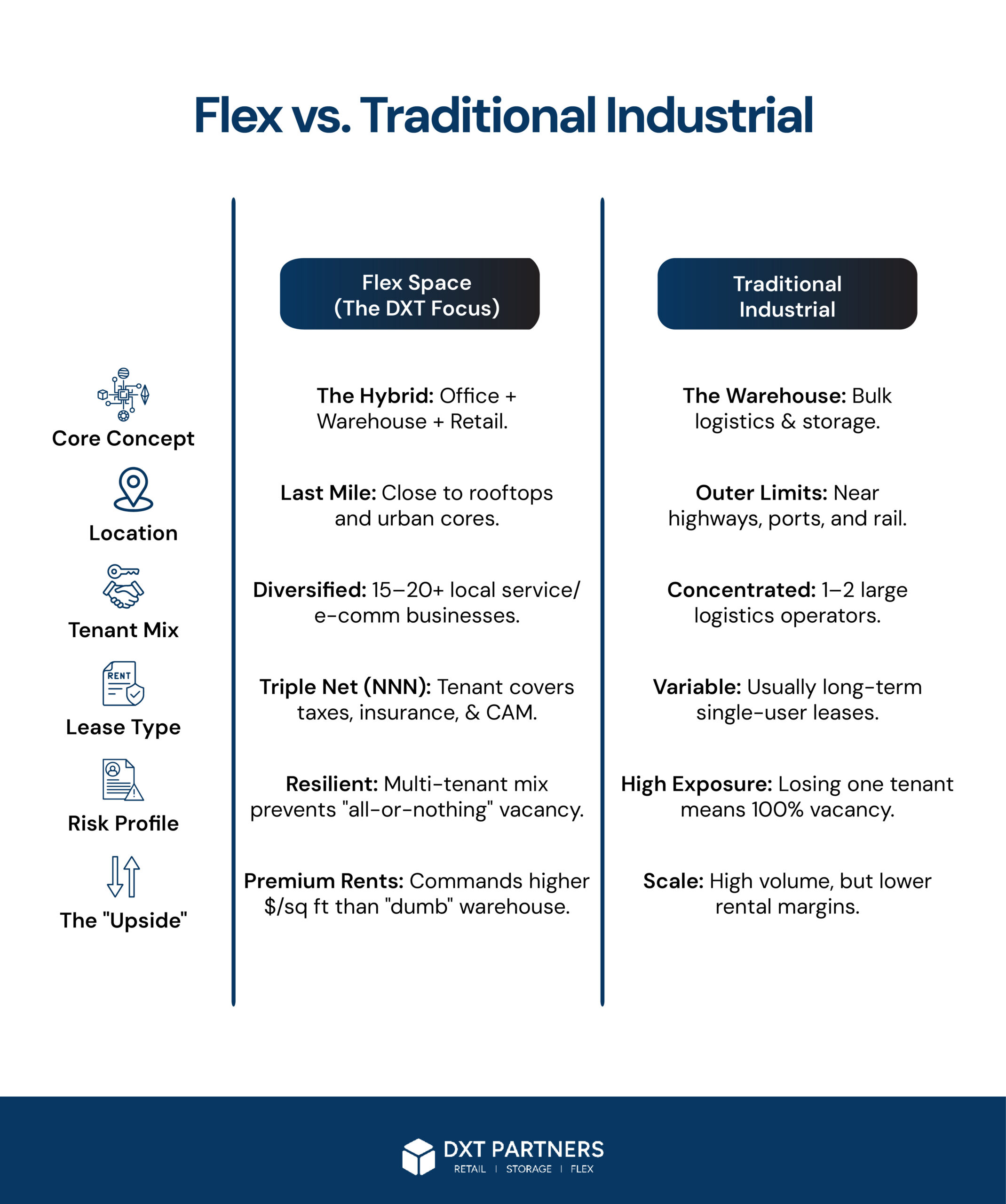
Factor | Flex Space | Traditional Industrial |
Core Concept | Hybrid space serving multiple small-to-mid businesses | Large-scale facility built for logistics and distribution |
Parking Demand | High (3–4 spaces per 1,000 – 2000/sq ft) due to multiple tenants, employees, and customers | Low relative to size; fewer employees per square foot |
Location Strategy | Near population centers (last-mile positioning) | Outside urban cores near highways, rail, and ports |
Tenant Mix | 15–20+ small businesses (HVAC, e-commerce, retail, services) | Single large tenant (logistics or industrial operator) |
Lease Structure | Shorter-term, staggered leases | Long-term lease with one tenant |
Risk Profile | Diversified income stream (built-in resilience) | Concentrated risk (tenant-dependent) |
Use Case | Local services, fulfillment, hybrid business operations | Bulk storage, manufacturing, large-scale distribution |
Here’s the same comparison in an infographic that you can save for later.
Why Flex Space Is the “Golden Child” of CRE Investing
From a pure investment fundamentals standpoint, flex space checks boxes that other asset classes simply cannot.
Here is why investors have been aggressively looking into this space:
- Triple Net (NNN) Leases: Most flex leases are structured as triple net agreements, meaning the tenant is responsible for property taxes, insurance, and maintenance costs, not the landlord. This dramatically reduces the operational burden on ownership and creates a more predictable net income stream.
- Diversified Tenant Base: Having a building occupied by a plumber, a software company, an e-commerce fulfillment house, and a medical equipment distributor is not messy, it is brilliant risk management.
- Low CapEx, High Adaptability: Turning over a flex unit between tenants rarely requires demolition or major renovation. This keeps capital expenditure low and occupancy gaps short.
- Rent Premiums: Flex space commands meaningfully higher per-square-foot rates than traditional “dumb” warehouse space. You are not just renting square footage, you are renting a business platform that combines professional identity (the office) with operational utility (the warehouse).
Who Uses Flex Space? The 2026 Tenant Mix
The modern flex tenant is not who you might expect. This is not simply storage for companies that ran out of room.
These are active, growing businesses building their operations from a flex platform:
E-Commerce & Last-Mile Delivery
Flex buildings are the backbone of modern retail. From regional fulfillment hubs to returns centers and direct-to-consumer brands, these businesses need small-to-medium industrial space close to their customers.
Service Trades
HVAC companies, electricians, plumbers, and contractors rely on flex space to run their operations. They get a professional office for clients and admin work, connected directly to a workspace for equipment, vehicles, and materials.
Creative & Tech Businesses
Maker spaces, Music teachers, podcast studios, R&D labs, and light manufacturing teams use flex space to combine production and presentation. They benefit from high ceilings for equipment, office areas for meetings, and the right zoning for operations.
The Flex Conversion Opportunity
One major opportunity today is converting well-located retail, storage, and select office properties into flex space. In the right markets, storage-to-small-flex warehouse conversions can double or triple rent per square foot.
DXT Partners targets undervalued assets where repositioning creates upside between purchase price and stabilized value.
The DXT Strategy: Investing in “Simple Metal Frame” Flex
At DXT Partners, we focus on a simple idea: build flexible, cost-efficient assets that adapt to demand.
Why Simple Works
Complex buildings are expensive and hard to modify. Simple metal frame structures—with clear-span interiors and grade-level access- are faster to build, cheaper to operate, and easier to reconfigure. That flexibility drives long-term value.
The Texas Advantage
Texas growth corridors (DFW, Austin–San Antonio, Houston) are seeing strong population and business migration. Pro-business policies and expanding infrastructure make them ideal for flex development, and we are positioned directly in these markets.
Off-Market Edge
The best deals never go public. We use data and strong industry relationships to source opportunities before they hit the market, allowing us to capture better pricing and upside.
Key Risks to Consider Before Buying Flex Space
No asset class is without risk, and it is important to address the challenges of flex space investing alongside the opportunities:
Zoning Hurdles
Flex approvals depend on local zoning and building presentation. Some municipalities permit flex uses in office or retail-designated areas, especially when the property maintains a retail-like facade. Before acquiring a site or existing building, investors should confirm permitted uses, access requirements, parking, loading, and any design restrictions early with local planning staff.
Over-Specialization
The greatest danger in flex development is building a unit so tailored to a specific tenant’s requirements that it becomes impossible to re-lease if that tenant vacates. Heavy built-in machinery mounts, specialty chemical storage, or custom cleanroom construction can eliminate 90% of the potential replacement tenant pool. At DXT Partners, we design and build for the widest possible tenant application, never for a single user.
Management Intensity
A single-tenant warehouse leased to a Fortune 500 logistics company essentially manages itself. A 20-unit flex building with 20 different small business tenants requires active, responsive, professional property management. Lease renewals are more frequent. Tenant improvement requests are more varied. Operational issues are more numerous. Investors who underestimate this management intensity, or who try to self-manage without the right systems, will struggle.
Is Flex Space Right for Your Portfolio?
Flex space sits at the intersection of two major trends: the decline of traditional office and the rapid growth of small businesses and e-commerce. It combines the stability of industrial assets with the higher returns typically seen in office, without the same vacancy risk.
In today’s uncertain market, flexibility is not just a feature. It is a strategy.
“We do not just invest in flex space. We invest in the businesses, communities, and economic corridors that flex space enables.”- DXT Partners
If you are a qualified investor exploring how flex can strengthen your portfolio, or looking for off-market opportunities in high-growth Texas corridors, the DXT Partners team can walk you through the strategy.