Types of Self Storage: A Guide to the Most Profitable Asset Classes
Drive through almost any mid-sized city in Texas and you’ll quickly notice a pattern: within a short radius, there are multiple types of storage facilities operating side by side. From the outside, they may appear nearly identical, rows of units, gated access, maybe a leasing office, but financially, they are entirely different businesses.
To make this easier to understand, here’s a quick breakdown before looking into them in detail:
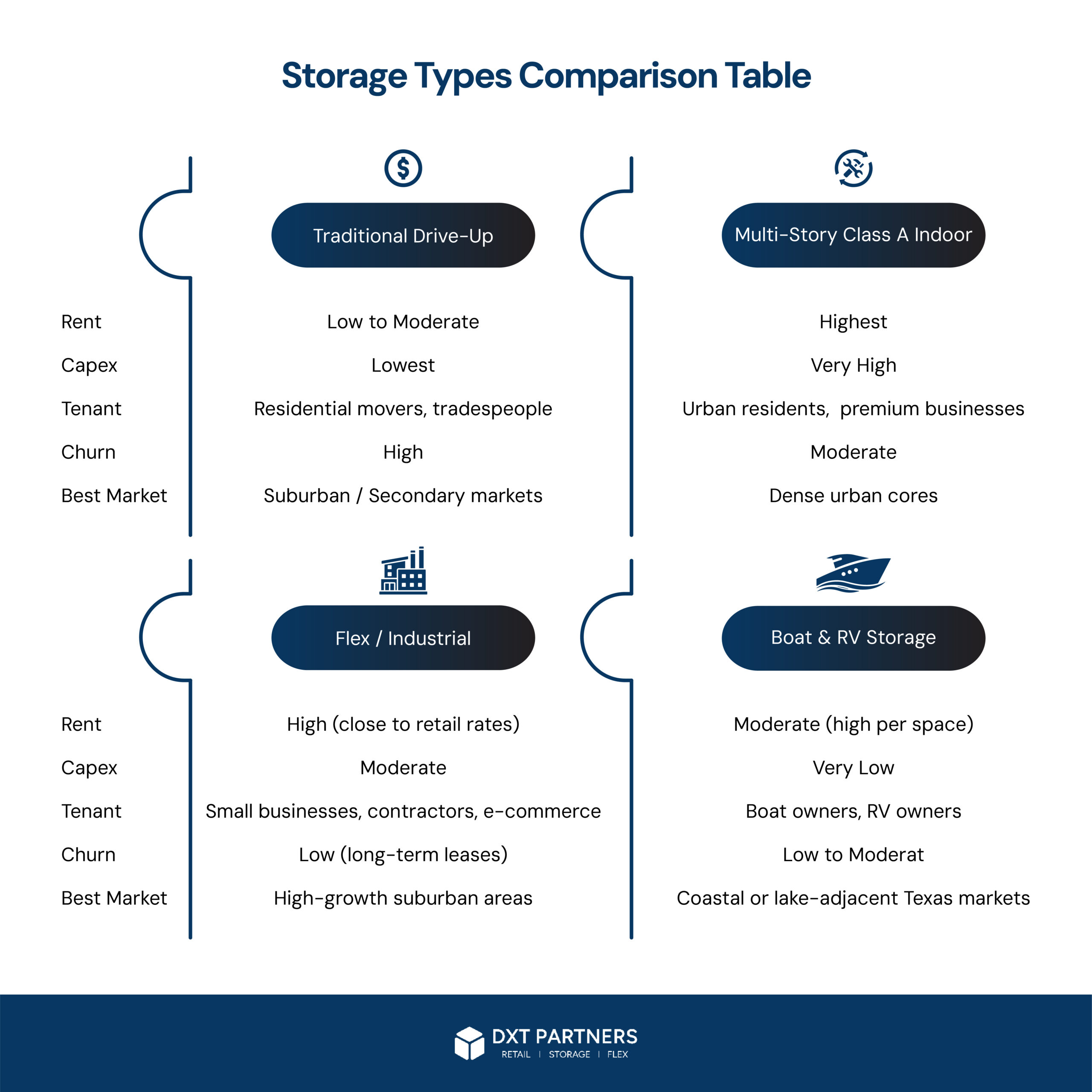
Key terms you need to know:
CAPEX (Capital Expenditure):
The upfront cost required to build or significantly upgrade the property. Lower CAPEX means less money tied up at the start.
Typical Tenant:
The primary type of customer using the facility (e.g., homeowners, businesses, contractors). This influences stability and pricing power.
Churn:
How often tenants move in and out. High churn means more vacancies and more management work; low churn means stable, predictable income.
Traditional Drive-Up Storage aka “The Workhorse”
This is what most people picture when they hear “storage unit.” Single-story, non-climate-controlled rows of metal roll-up doors. They’re built on slabs, simple to operate, and have been the backbone of the industry for decades.
Advantages vs. Limitations
Advantages | Limitations |
Lowest capital expenditure (CAPEX) to build | Lower rent per square foot vs. modern alternatives |
“Bulletproof” durability, minimal maintenance | Land-intensive, requires significant acreage |
Simple operations, low staffing needs | Limited differentiation from competitors |
Easiest to understand for lenders | Vulnerable to extreme Texas heat (tenant churn) |
DXT Insight: Drive-Up Can Command a Premium
In markets oversaturated by REIT-built multi-story buildings, our drive-up units often fetch a higher premium than climate-controlled units, especially those on upper floors of multi-story facilities.
Tradespeople, contractors, and local businesses frequently pay a premium for non-climate-controlled (NCC) storage because direct access is a functional requirement, not just a preference.
In certain infill locations, when REITs have overbuilt climate-controlled supply and driven down CC pricing, a well-positioned drive-up property can actually command rates above nearby climate-controlled competitors. This dynamic is something we actively monitor in all our acquisitions and projects.
Multi-Story Indoor Facilities: “The Modern Standard”
Walk into any Class A urban storage facility built in the last decade and you’ll find climate-controlled corridors, keypad access, freight elevators, and retail-style lobbies.
These are the premium hotels of storage, designed for dense urban markets where land is expensive and tenants expect more.
Advantages vs. Limitations
Advantages | Limitations |
High density, more units per acre of land | High utility costs, HVAC runs year-round |
Premium rental rates, especially climate-controlled units | Elevator maintenance is expensive and ongoing |
Attracts “Class A” urban tenants | Complex HVAC and fire suppression systems |
Modern tech integration (mobile access, etc.) | High CAPEX, slower ROI timeline |
Industrial Storage & Flex Space: “The Sleeping Giant”
This is where things become particularly compelling from an investor’s perspective, and where DXT has strategically focused.
Industrial storage and flex space buildings feature high ceilings (typically 18–24 ft clear height), wide bay doors, concrete floors, and flexible layouts that support a range of uses, from e-commerce fulfillment to light manufacturing and contractor operations.
Why “sleeping giant”?
For years, this asset class remained overlooked by institutional capital. It wasn’t glamorous enough for REIT portfolios and too complex for small operators. That gap created a significant opportunity for experienced, focused investors.
Advantages vs. Limitations
Advantages | Limitations |
Longer-term business tenants (1–5+ year leases) | Requires experienced operators to optimize unit mix |
Significantly lower churn vs. residential users | Zoning can be restrictive in some municipalities |
Higher rent per sq ft than traditional warehouses | Tenant improvements vary depending on use case |
NNN leases, tenants cover taxes, insurance, and CAM | |
Deep, underserved tenant pool in Texas suburbs | |
How DXT Thinks About Flex Space
We view flex space as essentially a hybrid product: a non-climate-controlled unit paired with a climate-controlled office space, plus a mailing address.
Small businesses, from music teachers and podcast studios to contractors and e-commerce operators, need something between a traditional storage unit and a 2,000–3,000 sq ft warehouse that’s simply too large for their needs.
We give them a small CC unit (as an office or workspace) plus the flexibility to scale their NCC space up or down. These tenants are long-term, less price-sensitive, and at some of our properties, they generate a higher $/sq ft on NCC than a typical storage tenant.
Our portfolio experience across multiple flex properties reinforces this: business tenants stabilize an asset. They sign longer leases, require less day-to-day management, and generate steady, predictable cash flow, exactly what investors prioritize.
Comparing “Conditioned” vs. Outdoor Storage
One of the most common questions investors ask is whether they need to offer climate-controlled (conditioned) storage.
In most parts of the country, it’s optional. In Texas, it’s a different conversation entirely.
Climate-Controlled (Conditioned) Storage
Texas heat and humidity make climate-controlled storage a strong value proposition, with tenants typically paying a 15–35% premium to protect sensitive items.
But that premium isn’t guaranteed. In some infill micro-markets, heavy REIT development has oversupplied climate-controlled units, pushing rents down. In these areas, well-located drive-up units can actually command higher rates, driven by convenience and direct access.
Investor takeaway: Climate control works, until it’s overbuilt. In certain submarkets, drive-up can outperform.
Outdoor / Drive-Up Storage: The Convenience Play
Don’t write off outdoor units, though. For tradespeople, landscapers, contractors, and small businesses with heavy equipment, outdoor drive-up access isn’t just a preference; it’s a requirement.
No elevator, no hallway, no hassle. Load the truck and go.
The ideal storage property combines both, climate-controlled interior units for residential and business tenants who need protection, and exterior drive-up units for the contractor who needs to back a trailer in at 6 a.m.
Out of all units, DXT’s Safe Harbor Storage of Clearlake in Kemah, TX (128,880 sq ft, 200 units) is a textbook example, offering both non-climate and climate storage, plus boat and RV parking, across a single asset.
Specialty Storage: High-Margin Niche Opportunities
Not all storage is created equal. Some of the most compelling returns in today’s market aren’t coming from traditional units, but from niche segments that combine strong demand, low development costs, and favorable tenant behavior.
Boat & RV Storage: The “Outdoor Storage” Boom
In Texas, demand for boat and RV storage is substantial, with 580,000–850,000+ registered boats and consistent undersupply in coastal and lake-adjacent markets.
What makes this asset class compelling is the “land bank” dynamic. Development is simple and cost-efficient: a secure, well-drained lot, basic infrastructure, and optional covered canopies, no HVAC, no elevators, just functional space. These assets also require significantly less day-to-day management than traditional storage.
Importantly, they are difficult to replicate in infill locations due to large land requirements. That constraint limits new supply and makes them more insulated from the overbuilding trends seen in multi-story climate-controlled assets.
Business & E-commerce Hubs: Where Storage Meets Industrial
The rise of e-commerce has created a new kind of tenant, one that sits between residential storage and traditional industrial users.
Unlike residential tenants, these users are long-term and growth-oriented.
The Asset Class Hierarchy: Class A, B, and C
While building type matters, the real performance driver often comes down to asset quality. Every storage investment falls into one of three categories, which are useful as they can drive your entry/exit strategy. So let’s take a closer look:
Class A: Stability at a Premium
These are newer assets, typically built within the last 10–15 years, featuring modern design, technology integration, and prime locations.
In practice, the best entry point is often new construction and lease-up, where the upside is created during stabilization rather than after. While stabilized Class A deals are more about preservation than growth, new development, when executed well, is where meaningful returns can be captured, and it’s something we consistently evaluate alongside acquisitions.
Class B: The Value-Add Sweet Spot
Class B assets, usually 10–20+ years old, are where the most attractive opportunities exist.
They have solid fundamentals but suffer from outdated management, deferred maintenance, or below-market rents. This creates a clear path to value creation: acquire below replacement cost, improve operations, increase income, and unlock equity.
This is where experienced operators focus, because it offers the best balance of risk, control, and upside.
DXT’s deliberate focus on Class B value-add properties in the greater Houston MSA is not accidental. It’s where the best risk-adjusted returns live, you’re buying real, operating assets below replacement cost, then creating equity through strategic improvements.
And mostly, the building types DXT targets, drive-up, flex, and Boat/RV combinations, are ideally suited to Class B repositioning because they don’t require the multi-million-dollar gut renovations that a multi-story indoor facility might.
Class C: High Risk, High Potential
These are older (20–40+ years) “mom-and-pop” properties, often in rural or secondary markets.
They come with operational inefficiencies and higher risk, but also the potential for forced appreciation through basic improvements like rent optimization, security upgrades, and better management.
The key is selectivity. In the right growth corridor, even a Class C asset can become a high-performing investment.
The DXT Strategy: Why We Use “Simple Metal Frame” Buildings
At the core of DXT’s approach is a simple principle: a well-designed building should be flexible enough to adapt to market demand over time, while still being positioned for the strongest possible exit value.
Every decision is made with two goals in mind: maximize in-place cash flow and optimize long-term exit value.
Versatility: One Building, Multiple Income Streams
A single metal-frame structure can support retail, traditional storage, and flex space under one roof. This allows us to adjust the unit mix based on real-time demand and maximize income per square foot, rather than being locked into a single use case.
Speed to Market: Faster Path to Cash Flow
Simple construction means fewer delays, faster approvals, and quicker lease-up. The result: faster “Day 1” cash flow, rather than waiting years for stabilization.
Adaptability: Built to Pivot
As demand shifts, so does the asset. Standard storage units can be converted into larger flex bays (e.g., 10×10 units into 1,000 sq ft spaces) without rebuilding. This level of flexibility is more difficult, but we have seen it done.
Which Type of Storage Unit is Best for Your Portfolio?
There isn’t a single “best” strategy, each asset type can work, depending on the submarket, supply pipeline, and competitive moat around the deal.
The real edge comes from matching the right structure to the right location and anticipating where institutional capital (like REITs or large developers) may enter next.
- Value-add Class B assets often provide the fastest path to equity creation with relatively controlled downside. These deals are harder to source, but when executed well, they allow for immediate operational improvements and rent upside without taking full development risk.
- Multi-story climate-controlled (Class A) facilities carry more complexity and higher execution risk, particularly in markets where institutional players may later compete. However, in the right high-density submarket with strong barriers to entry and the right capital partner, they can generate some of the strongest long-term stabilized value.
- Drive-up, climate, and hybrid facilities continue to serve as the backbone of suburban demand, particularly when positioned correctly within undersupplied corridors and protected from overbuilding through zoning or land constraints.
At DXT Partners, the focus is not on choosing one category over another, but on identifying where each asset type fits best within a specific market cycle, and ensuring every deal has a defensible moat against future competition, whether from REITs, developers, or expanding operators.
Picking a Winner in the Storage Space
There’s no single “best” storage type, it depends on market and execution. That said, flex space and value-add Class B assets are currently delivering some of the strongest risk-adjusted returns in Texas suburbs.
Boat and RV storage continues to perform well in coastal and lake markets due to strong demand and limited supply. Class A multi-story storage remains an institutional-quality product, often best suited for dense urban areas and long-term capital strategies.
At DXT Partners, our core focus is on flexible, simple metal-frame developments and Class B value-add opportunities, but we also actively evaluate Class A development and other asset types when the right land parcels and market conditions arise. Our approach stays opportunistic, guided by fundamentals and long-term value creation.