Self-storage used to be one of real estate’s better-kept secrets. Word got out. By 2024, the U.S. industry had surpassed $44 billion in annual revenue and grown into one of the most-watched segments of commercial real estate1.
Institutional capital poured in. Cap rates compressed.
The days of buying any storage facility and watching cash flow follow automatically are over.
But here’s what hasn’t changed: the underlying demand drivers are as strong as ever, and in our experience operating facilities across Texas through one of the most challenging housing markets in recent memory, the “recession-resilience” label has more than held up.
In fact our properties have maintained 80-90% occupancy even while home sales have been sluggish. The opportunity hasn’t disappeared. It’s just gotten more specific.
The investors doing well today are the ones who can find properties with real upside, operate them well, and buy at prices that make the math work from day one.
That’s the game we’re playing!
The Numbers: What Kind of Returns Can You Actually Expect?
Before getting into what moves the needle, let’s ground this in realistic figures.
Self-storage generates NOI margins of 60 – 70%, among the highest of any real estate asset class.
Net Operating Income (NOI) is the metric that matters most in storage. It’s simple: gross revenue minus operating expenses. That number determines your property’s value, your cash flow, and ultimately, what you can get for it when you sell or refinance.
On a cash-on-cash basis, annual returns for stabilized storage facilities typically land in the 8–12% range. That figure can rise meaningfully for value-add plays, which we’ll discuss in depth below.
Cap rates for stabilized, listed storage properties are currently in the 5.5 — 6.5% range depending on asset class, market, and property quality.
Class A assets in core markets trade closer to the low end of that range, while Class B and C properties in secondary and tertiary markets can trade higher.
At DXT, our acquisition targets focus on that Class B/C range, properties where we can buy at better economics and then drive value through improved operations, not by hoping the market does us favors.
Are Storage Units a Good Investment Right Now? (The “Why”)
There’s a reason self-storage has outpaced inflation in NOI growth consistently since 2008, navigating two recessions, a financial crisis, and a global pandemic along the way. The demand drivers are not tied to a single economic condition.
They’re tied to life.
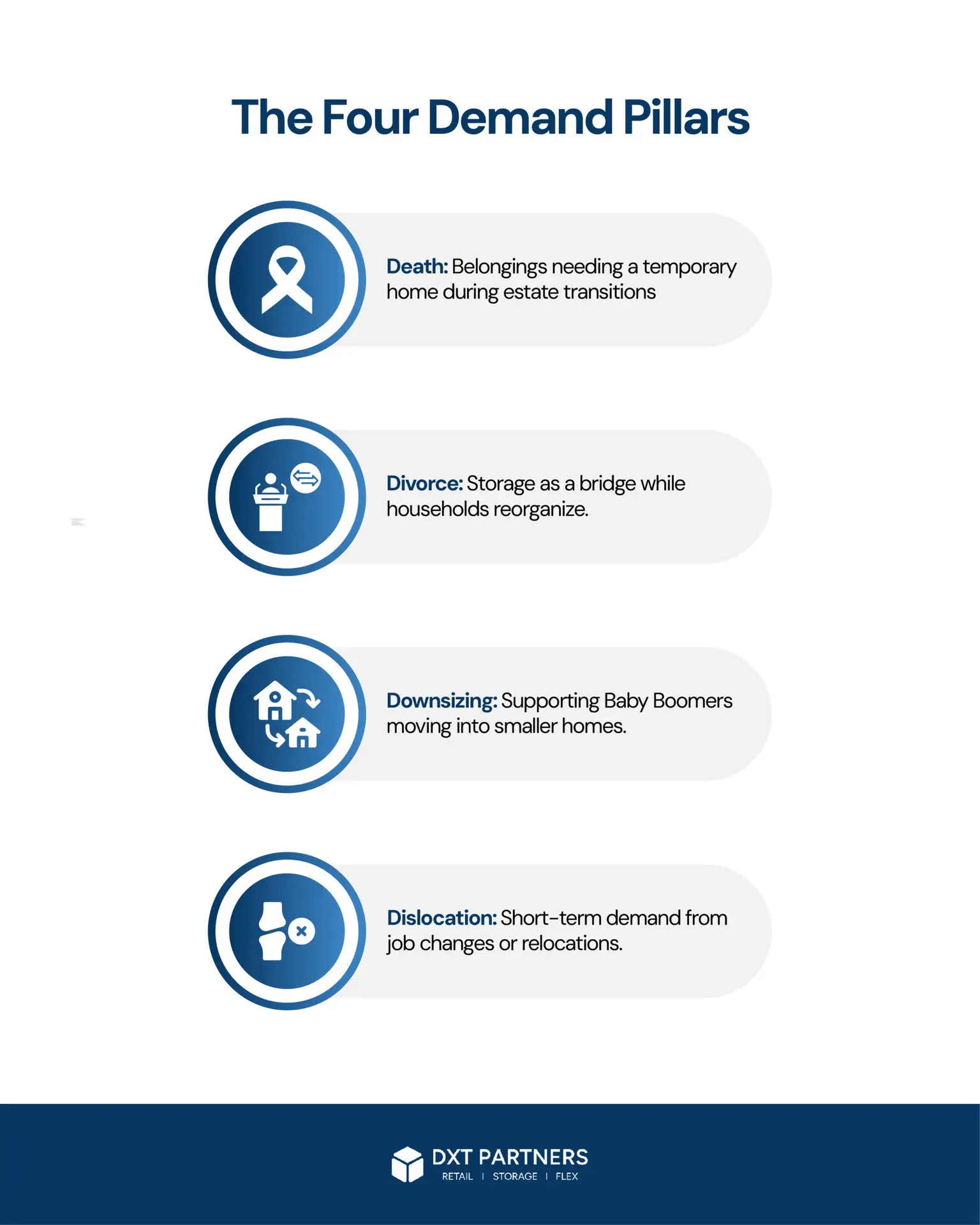
The four demand pillars we see play out again and again are what the industry calls the “Four D’s”:
- Death: When a family member passes, belongings need somewhere to go, often for years.
- Divorce: One household becomes two smaller ones. Storage fills the gap while life reorganizes.
- Downsizing: Baby boomers moving from large homes to smaller ones are creating decades of accumulated possessions that need a home.
- Dislocation: Job changes, relocations, corporate transfers, all produce short- and medium-term storage demand.
What we’re seeing on the ground is clear: the housing market has been effectively frozen for the past couple of years, with high mortgage rates keeping people in place and home sales quite low.
Yet our properties continue to maintain strong occupancy. That reinforces an important point, storage demand isn’t only driven by moving; it’s driven by life events that continue in every cycle.
What Separates Good Returns from Great Ones
At DXT, we focus heavily on two things: how we buy and how we operate.
We believe these matter more than almost anything else. Location sets the ceiling for a deal and operations determine how close you get to it.
Location and sub-markets. Texas leads the country in self-storage supply, driven by strong population growth in cities like Houston, Dallas-Fort Worth, San Antonio, and Austin.
Unit mix. While climate-controlled units are often assumed to be superior, we’ve seen markets like Houston where drive-up units can achieve comparable or even higher rents due to demand for convenience.
Operations. This is where we create the most value. When we acquire a facility, especially one that has been under-managed, we upgrade the operating model, online leasing, digital marketing, local lead generation, automated billing, and contactless access.
Across the industry, most customer interactions are now digital, and automation can significantly reduce labor needs, directly improving NOI.
Emerging Trends: What’s Next for Self-Storage in 2026?
A few trends are defining the landscape right now, and they’re mostly favorable for buyers who are disciplined about where and how they invest.
- Supply is pulling back. After a construction surge in 2020–2023, deliveries are declining sharply. Completions are projected to drop to around 400 facilities in 2025, then gradually recover, and in oversupplied markets, this runway is giving existing operators time to stabilize occupancy and rates.
- Rental rates are stabilizing. After a soft patch driven by new supply and a frozen housing market, street rates have leveled off and are expected to grow 1–3% in 2026. Not explosive, but a foundation to build on.
- Transaction activity is recovering. After a sharp slowdown in 2023–2024 driven by higher interest rates, deal flow has begun to improve as pricing expectations reset and borrowing conditions gradually stabilize.
- Housing remains a key demand driver. Self-storage demand remains closely tied to housing mobility.
The “DXT Secret”: How to Beat Average Returns
The problem with listed deals.
When a storage facility shows up in a broker’s newsletter, every credible buyer in the country can see it within hours.
Sellers with brokers are typically well-informed about what their property is worth. Competition is fierce, pricing is full, and the opportunity to buy at a price that gives you real upside is limited.
How we find the right deals.
Our sourcing strategy is built around reaching motivated sellers before anyone else does.
We reach them through direct outreach, local networks, and the kind of personalized engagement that a virtual assistant cold-call campaign can’t replicate. When a seller chooses to work with us, it’s usually because they trust us, and that trust shows up in better pricing and better deal terms for our investors.
The refinance-and-return model.
Once we acquire a property, improve operations, and stabilize occupancy and income, we look to refinance the asset at its new, higher value.
We pair this with a long-term hold mentality. We’re not flipping storage facilities.
We’re building a portfolio of well-operated assets in markets we understand deeply, distributing cash flow along the way, and positioning for a sale only when the price is genuinely compelling.

Challenges and Risks: What You Need to Know
Self-storage is a strong asset class, but it’s not without risks. And here are a few:
- Oversupplied markets. Before buying anywhere, you need to understand the local supply pipeline, not just what exists today, but what’s permitted and under construction within your trade area.
- Customer acquisition costs. Self-storage has always been a local marketing business. Digital advertising costs have risen materially as more operators compete for the same online traffic.
- Passive doesn’t mean ignored. Self-storage is sometimes sold as “passive income with minimal effort.” We think that framing does investors more harm. While the day-to-day operations are lean, the results you get are a direct function of the attention and discipline you bring to management. The properties that underperform are almost always the ones where someone took the “passive” label too literally.
How to Get Started in Self-Storage Investment
Direct ownership vs. syndication:
If you have the operational bandwidth, capital, and appetite to run a facility yourself, direct ownership can be highly rewarding.
Key things to evaluate in any deal, regardless of your approach:
- Sub-market fundamentals: population trends, income levels, competition density, and supply pipeline within a three-mile radius.
- Current vs. market rents: is the facility charging market rates, or is there meaningful upside from a simple rent-to-market strategy?
- Operational quality: what does the current operator’s marketing look like? Is the facility digitally visible? What’s the delinquency rate?
- Physical condition: deferred maintenance is a cost you’re acquiring, not just a discount. Know what you’re walking into.
- Deal structure: how does the capital stack work? Is there a sensible path to refinancing and returning capital?
If you’re interested in how DXT evaluates deals and where we’re actively looking, the best first step is to join our investor newsletter or reach out directly.
Final Verdict: Are Storage Units Profitable?
Yes, but the bar is higher than it used to be. The investors who are generating strong returns today aren’t doing it by buying any storage facility and hoping for the best.
Self-storage still offers what originally made it compelling: high margins, low labor overhead, month-to-month lease flexibility that keeps you protected against inflation, and resilient demand that doesn’t depend on a single economic condition. Those fundamentals haven’t changed.
Join the DXT Partners investor newsletter to receive market insights, deal updates, and early access to our current offerings. Or visit our website to learn more about how we invest.