Glimpse into The Self Storage Market in 2026
Roughly one in three Americans currently rents a storage unit, and the U.S. market is projected to expand from approximately $45 billion in 2025 to nearly $58 billion by 2031, reflecting a steady 4.1% compound annual growth rate.
What makes this asset class attractive is structural demand. Self-storage benefits from what industry veterans call the “Four Ds”: Death, Divorce, Downsizing, and Dislocation.
These life events occur in every economic cycle, which is precisely why, since the National Council of Real Estate Investment Fiduciaries (NCREIF) began tracking the sector in 2005, self-storage has delivered the highest average annual total returns among all commercial real estate categories.
The “Mini-Storage” Business Plan: How to Start from Scratch
It begins with three things most aspiring operators underestimate: disciplined market research, a clear-eyed approach to zoning entitlements, and a strategic choice between buying an existing facility versus building new.
Market Research & Feasibility
Professional feasibility studies define a “catchment area” of 3 to 5 miles around a proposed site. Within that radius, analysts evaluate existing supply (measured in square feet of storage per capita), population growth trends, household income, move rates, and rental rate benchmarks.
The Self Storage Association recommends targeting markets with fewer than 7 square feet of storage per capita as a general indicator of undersupply. However, square feet per capita metrics can be misleading. Using it as one of several primary metrics for market feasibility is paramount
Zoning & Entitlements: The Silent Killer of Storage Dreams
Local municipalities increasingly view self-storage as a low-tax-revenue land use compared to retail or light industrial uses, making zoning approvals harder to obtain than they were a decade ago.
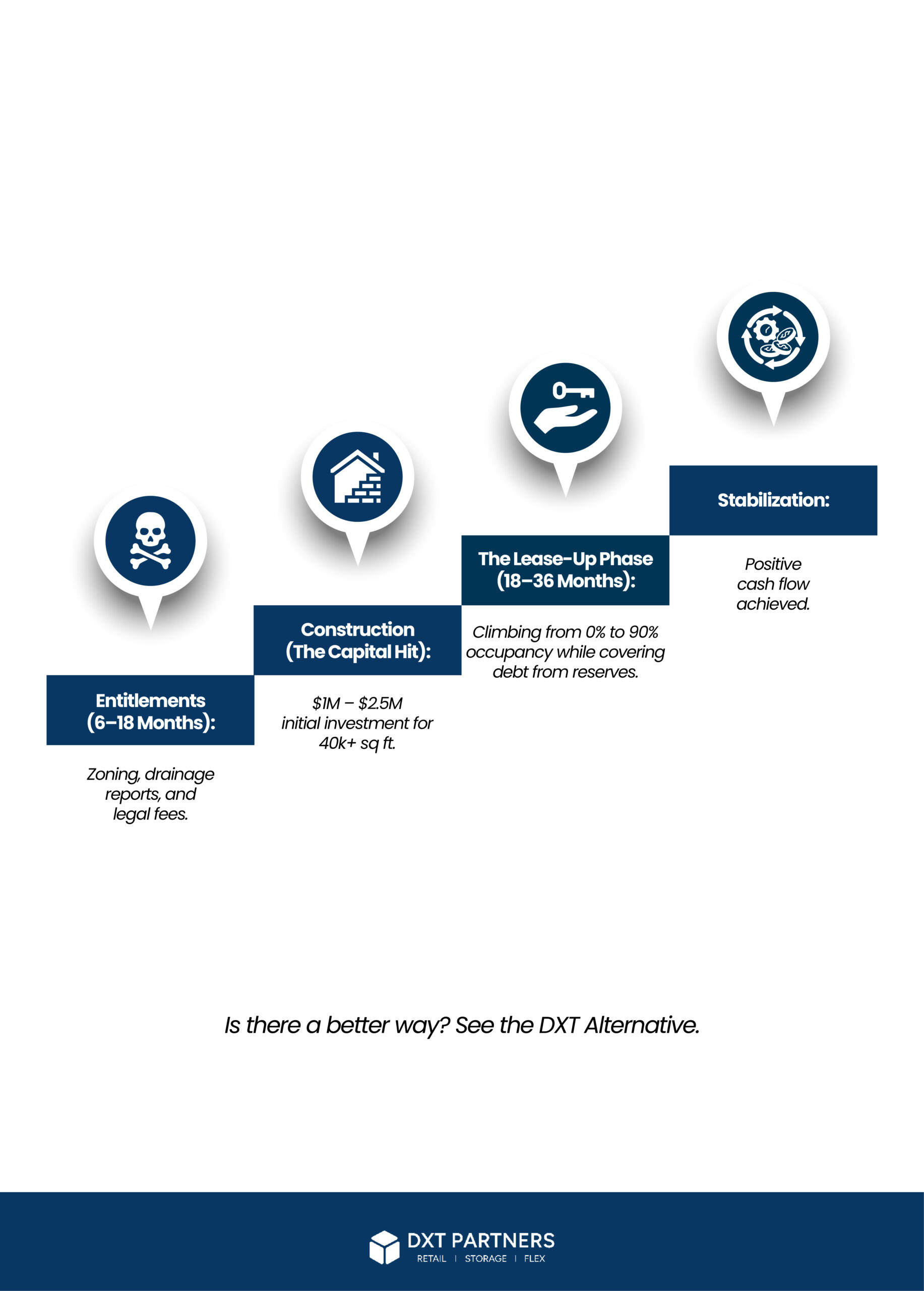
In some cases, expect 6 to 18 months for entitlement timelines in suburban Texas markets, plus engineering studies, traffic impact analyses, drainage reports, and conditional use permits.
Choosing Your Model
Once zoned and entitled, you face the first major strategic fork in the road:
- Acquiring a distressed existing facility vs. ground-up development: Acquisitions offer immediate cash flow but may require capital improvements. Ground-up development means you build precisely what the market needs, at a higher upfront cost and with an extended lease-up period before you turn profitable.
- Traditional staffed facilities vs. fully automated remote management: Modern technology, Noke smart locks, cloud-based access control, automated billing platforms, and networked security cameras have made fully remote management not only viable but often more profitable by eliminating payroll for on-site managers.
The Financials: What It Actually Costs to Start a Self Storage Business
If you want to enter this business professionally, it requires serious capital and a realistic financial model that accounts for the full project timeline.
Startup Cost Breakdown
- Land Acquisition: Target 25–30% of total project budget. Quality commercial land near major Texas corridors can range from $5 to more than $20 per square foot, depending on the submarket and proximity to population density.
- Construction: Metal frame single-story drive-up facilities typically cost $65–$75 per square foot. Climate-controlled, multi-story buildings run $100+ per square foot or higher, driven by mechanical systems, concrete construction, and, increasingly, tariff pressure on steel and building materials.
- Soft Costs: Budget an additional 10–15% for permits, engineering, architectural drawings, feasibility studies, and legal fees. These costs are incurred before a single unit is built.
All in, a professionally developed facility of 40,000 to 60,000 rentable square feet, the approximate minimum to achieve meaningful operational efficiency, requires $4 million to $5 million in total project capital. Smaller backyard projects exist, but they rarely achieve the economies of scale needed to compete with professionally managed facilities.
Operating Expenses (OpEx)
The ongoing cost structure includes property taxes (which have risen substantially across Texas growth markets), casualty insurance, utilities, maintenance labor, and an often-underestimated marketing budget. A stabilized facility typically operates at a 35–45% expense ratio. Everything above that line, after debt service and reserves, flows to the owner.
Reality Check: The “low maintenance” stance ignores the marketing machine. In 2026, self-storage is not passive income; it is very active, hands-on management designed to maximize returns. The operators who treat it passively are the ones selling distressed facilities.
Opening a Storage Facility: The Step-by-Step Launch
Step 1: The Building Phase
Most new Texas facilities use metal frame construction for cost efficiency. Single-story, drive-up units dominate suburban markets. Multi-story, climate-controlled buildings command higher rents in denser locations but require more capital and patience.
Equally important is unit mix planning. The right balance of unit sizes (e.g., 5×5, 10×10, 10×20) must align with local demand. An inefficient unit mix can slow lease-up, reduce achievable rental rates, and impact long-term occupancy performance.
Step 2: The Tech Stack
Modern self-storage is fundamentally a technology-enabled business. A complete operational tech stack includes a property management system (Storable, Sitelink, or similar), cloud-based access control, automated billing and collections, monitored security camera systems, and a website built for local SEO performance.
Step 3: The Lease-Up Phase
Developers must also decide whether to build the project in phases or all at once. Phased development can reduce upfront capital requirements and align supply with demand over time, improving lease-up velocity. In contrast, building the full facility at once increases initial vacancy risk and can pressure rental rates if supply outpaces demand in the early stages.
This is the highest-risk period of any storage development: the first 12 to 24 months following opening. A newly built facility begins at 0% occupancy and must climb toward the 85–90% threshold. Lease-up speed is heavily influenced by pricing strategy, marketing execution, and how well the unit mix matches local demand.
During lease-up, debt service is typically covered from reserves. The average stabilization timeline in a competitive Texas market is 18 to 36 months. Professional operators model this in advance. First-timers frequently do not.
Operational Challenges: What the Reddit Threads Won’t Tell You
The Maintenance Myth
Self storage is marketed as low-maintenance real estate. The truth is quite different. Security cameras fail. Gate systems malfunction, often at 2 AM on a holiday weekend. Units require cleaning after tenant turnover. Pest control, roof maintenance, and parking lot upkeep are recurring operating costs.
The Human Factor: Navigating the Four D’s
Storage customers are frequently in a difficult chapter of their lives. Handling the emotions tied to Death, Divorce, Downsizing, and Dislocation, combined with delinquent accounts, lien sales, and unit cleanouts, requires genuine people skills, empathetic communication, and clear operational processes. The customer service demands of self-storage are consistently underestimated by prospective operators.
Legal Pitfalls: Texas Lien Laws
Texas has specific statutory requirements governing the lien process for non-paying tenants, defined under Texas Property Code Chapter 59. Operators must follow exact notice timelines, advertise auctions in qualified publications, and comply with auction procedures. Failure to execute correctly can result in civil liability.
The DXT Partners Alternative: Own the Asset Class Without Running the Business
Here is the honest question this entire guide builds toward: Do you want to run a self-storage business, or do you want to own a self-storage asset?
Owning a share of a professionally operated self-storage asset means receiving quarterly distributions while an experienced operator handles every operational detail.
Scale & Alpha: Why Off-Market Sourcing Wins
The self-storage market remains fragmented. The top 100 operators control approximately 51% of total national inventory, while roughly 14,000 smaller owners hold the remaining half
DXT Partners targets that second group, specifically, transitioning-generation owners who value a trusted buyer relationship over a public listing process.
The Flex Space Evolution: Beyond Traditional Storage
Flex tenants typically sign longer leases and pay higher per-square-foot rents than residential storage users, improving income stability and reducing turnover costs. With a single metal frame building, DXT can configure space for its highest and best use, retail, storage, or flex, maximizing return on every square foot acquired.
Conclusion: Is Starting a Storage Company Right for You?
Self-storage is a strong, growing industry, projected to expand from $45B to $58B by 2031, with solid fundamentals and demand.
But building from scratch in 2026 isn’t simple. It requires $2M+ capital, long approval timelines, and 18–36 months to stabilize, plus active management. The idea of “passive income” is often overstated and most times untrue.
If you enjoy building and operating businesses, it can be a great path. If you prefer returns without the operational burden, partnering with experienced operators is the smarter move.
The era of “easy” storage is over. Rising costs and competition mean professional execution is now the baseline. For those looking to invest without running the business, that’s where DXT comes in.