What Is Small Bay Flex Space?
A small bay flex space is a multi-tenant industrial unit, typically ranging from 1,500 to 5,000 square feet, inside a larger building that is subdivided into individual bays. Each bay gets its own roll-up door (grade-level, not dock-high), its own restroom, its own electrical service, and a small front-office or mezzanine finish area covering roughly 15 to 25% of the total space. The rest is open warehouse or workshop floor.
Clear heights run between 14 and 24 feet, which is high enough for pallet racking, vehicle lifts, or light manufacturing equipment, but not so high that you are paying for space no one uses.
Grade-level roll-up doors (typically 10×10 or 12×12 feet) allow tenants to drive vehicles directly in, which is essential for trade contractors, auto-related businesses, and anyone receiving frequent deliveries without a loading dock.
One of the most important features of small bay is what it calls ‘flex.’ A single building can house a plumbing contractor in one bay, a CrossFit gym next door, a custom furniture maker two doors down, and an e-commerce fulfillment operation at the end of the row. The space works for all of them because the physical design does not force a single use. That flexibility is what drives consistently high occupancy: when one tenant type slows down, another category picks up the slack.
In the Sun Belt, one upgrade is increasingly separating premium small bay assets from older vintage stock: climate control. As Texas summers intensify and tenants increasingly store electronics, cosmetics, pharmaceuticals, and finished goods, demand for conditioned small bays has grown sharply.
At DXT, we factor HVAC infrastructure into every value-add project we evaluate because it directly impacts achievable rents and the quality of tenants we can attract.
The “Structural Scarcity” of Small Bay Industrial Real Estate
Here is the core of the investment case: there is a long-term supply-demand imbalance in many U.S. small bay industrial markets, driven by limited new development and strong tenant demand.
The construction economics can be more challenging than those of large-box industrial projects. Building a 500,000-square-foot distribution center is far simpler than building fifty individual 2,000-square-foot bays. The big box requires one loading dock design, one HVAC system, one utility connection, and one tenant relationship. The small bay project requires fifty overhead doors, fifty electrical services, fifty plumbing hook-ups, and an on-site management system that can handle fifty lease relationships.
Developers who can earn the same income for less complexity will always choose the simpler project. That is why U.S. industrial construction starts fell 35% year-over-year in late 2023 and have continued to decline, and virtually none of the new supply coming online is small bay.
The land equation makes it even worse. Small bay thrives in infill locations, close to city centers, where tenants can reach their customers quickly. But those same infill sites have become too expensive for most new low-density industrial development. The land cost per square foot is simply too high to justify building single-story warehouses when the same parcel could support multifamily housing or a mixed-use retail project.
Existing small bay landlords often benefit from meaningful pricing power at lease renewal, particularly in supply-constrained submarkets When a tenant’s lease expires and there are no comparable alternatives within a 10-mile radius, that tenant renews at whatever rate the landlord sets, or faces an expensive, operationally disruptive relocation. That dynamic gives small bay owners a structural advantage that no other asset class in commercial real estate currently enjoys.
Small bay industrial properties under 100,000 sq ft maintain a national vacancy of approximately 4%, while large industrial properties over 700,000 sq ft sit closer to 9%. The smaller the building, the tighter the market.
The Tenant Mix: Who Is Renting Small Bay Warehouses?
The diversity of small bay tenants is both the secret to its resilience and the main reason investors underestimate it. This is not a single-industry play. The tenant base is broad, local, and built on essential services that do not disappear in a downturn.
The Service Class:
The backbone of small bay demand. HVAC contractors, plumbers, electricians, landscapers, and pest control companies all need a professional base of operations with a roll-up door for their trucks, storage for equipment and parts, and a small office to handle admin and customer intake. These businesses are not going remote. They are not being automated. They are growing because the homes and businesses in Texas’s booming cities constantly need their services.
The Digital Class:
E-commerce brands that have outgrown their garage but do not need a full warehouse lease. A 2,500-square-foot bay is perfect for storing inventory, processing returns, and shipping out 50 to 200 orders per day. As last-mile delivery economics push fulfillment closer to end consumers, these tenants are actively seeking small bay space near residential density.
The Quasi-Retail Class:
CrossFit gyms, specialty car storage, audio production studios, custom fabricators, and showroom-warehouse hybrids. This category is growing quickly and pays some of the highest per-square-foot rents because these operators need a physical address that is accessible to customers but priced below traditional retail.
What all three groups share is essential, local, and hard-to-replicate business models. They are not Fortune 500 tenants that can be absorbed by a competitor overnight. They are the plumber you call at midnight, the gym your neighbors belong to, and the flooring contractor finishing half the new homes in your suburb. These tenants show up, pay rent, and renew their leases.
Comparing Small Bay vs. Large Bay Industrial
The table below compares the two formats across the metrics that matter most to investors:
Feature | Small Bay Flex | Large Bay Industrial |
Unit Size | 1,500 – 5,000 sq ft | 50,000 – 500,000 sq ft |
Tenant Count | 10 – 30 tenants | 1 – 3 tenants |
Vacancy Risk | Low (~4% national avg) | Higher (up to 9%+) |
Rent / Sq Ft | Premium ($14 – $20+) | Discounted ($7 – $10) |
Lease Terms | Shorter & flexible | Long-term (5–15 yrs) |
Income Diversity | High | Very Low |
Loading Access | Grade-level roll-up doors | Dock-high loading |
Clear Height | 14 – 24 feet | 32 – 40 feet |
Recession Resilience | High (essential tenants) | Moderate to Low |
The data is clear: small bay outperforms large bay on every risk-adjusted metric. The premium rent, combined with near-zero vacancy and true tenant diversification, makes small bay the superior income asset.
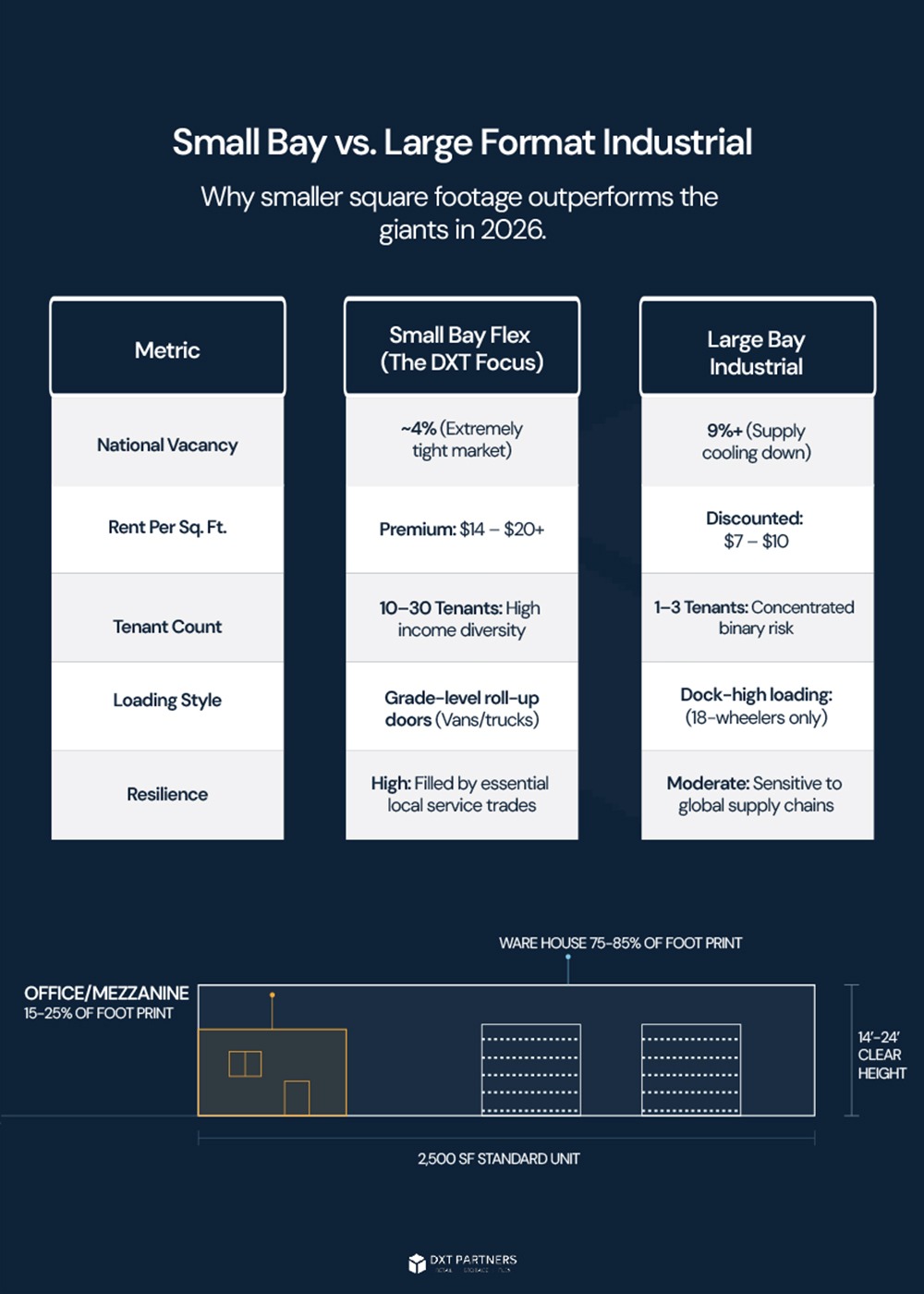
The only column where large bay wins is management simplicity, which brings us to a key part of the DXT strategy.
Why DXT Partners Focuses on Small Bay Industrial in Texas
Texas is not just a good market for small bay industrial. It is arguably the best market in America for this asset class right now, and the reasons are structural rather than speculative.
Population migration
Texas has added millions of new residents in the past decade, and that growth is accelerating. Every new resident needs plumbers, HVAC technicians, electricians, and landscapers. Every new home and office building creates ongoing service demand. The population that is moving into Texas is simultaneously creating the tenant base that fills small bay industrial parks.
The entrepreneurial boom
Texas consistently leads the nation in small business formation. New businesses need space before they need anything else. A flooring company starting up does not need 20,000 square feet; it needs 2,500 square feet with a roll-up door, good electrical service, and a small office. Texas’s business-friendly tax and regulatory environment accelerates this formation rate, keeping small bay demand elevated even when national economic conditions soften.
Our portfolio already spans over 458,000 square feet and $130M+ in assets under management, and small bay flex space is one of our primary focus areas. View our current flex space projects to see this strategy in action.
Investment Risks: What to Watch For
Strong returns always come with real risks, and small bay industrial is no exception. Here is what experienced operators watch closely, and how we manage each one at DXT.
Management intensity.
Managing 20 small tenants is fundamentally different from managing one large corporate tenant. Lease administration, maintenance requests, collections, and turnover are all more frequent. This is why most passive investors cannot do this alone: small bay requires a professional operator on the ground. DXT’s team handles all asset management, leasing, and maintenance in-house, which is one of the primary reasons our investors choose to partner with us rather than attempting to acquire and operate these assets independently.
Zoning evolution.
In high-growth Texas markets, infill industrial land is increasingly attractive to multifamily and mixed-use developers. While rezoning pressure can create uncertainty around future land use and redevelopment options, it can also strengthen the position of existing small-bay industrial assets. In many cases, operating properties are grandfathered under existing regulations, allowing them to continue serving tenants even as new industrial development becomes more difficult. This restricted future supply can create a long-term competitive advantage for well-located small-bay projects. We evaluate each acquisition carefully by reviewing surrounding land uses, city planning documents, and long-term development trends before committing capital.
Power infrastructure.
Modern small bay tenants, particularly light manufacturers, EV service shops, and tech-adjacent businesses, are consuming significantly more electrical power than tenants from even 10 years ago. A vintage building with 100-amp single-phase service per bay may struggle to attract today’s best-paying tenants. We always assess the electrical infrastructure of every acquisition target and budget for upgrades where needed, because the cost of adding three-phase power or upgrading panel capacity is almost always recovered within the first two years of improved rents.
Conclusion: The Future of Industrial Flex Space
Small bay flex space is no longer the ‘bottom’ of the industrial market, written off as unglamorous or too operationally intensive for serious investors. It is, in 2026, one of the most compelling asset classes in all of commercial real estate. The supply shortage is structural and growing.
The investors who recognized this five years ago are sitting on compounding equity and premium income. The investors who recognize it today are still buying at prices that make sense. The investors who wait another five years will be competing against institutional capital that has already flooded this space.
At DXT Partners, we are actively acquiring, improving, and managing small bay flex space assets across Texas on behalf of our investor partners.
If you want to understand what our current projects look like, what our return structure is, and whether this strategy fits your investment goals, we invite you to view our current portfolio or schedule a direct conversation with our team. The opportunity is real, the market is moving, and the time to look closely is right now.