First, Let’s Talk About What a Real Estate Fund Actually Is
A real estate fund is a structure where a fund manager raises a large pool of money from investors and then uses that capital to buy multiple properties over time. Investors commit money upfront without knowing exactly which buildings will be purchased. This is sometimes called a “blind pool” because you are basically writing a check based on a general strategy rather than a specific deal.
There are some upsides. Funds give you exposure to multiple properties across a market, which spreads your risk. If one building underperforms, the others can offset it. And if you like a “set it and forget it” approach, a fund might feel comfortable.
But there are real trade-offs too.
With a typical fund, the manager is paid based on assets under management (AUM), meaning they earn fees based on how much money they have raised, not necessarily how well your investment performs. This creates a situation where their incentive is to grow the fund as big as possible, rather than to maximize returns on any single deal.
There is another pressure that rarely gets talked about: capital sitting in a fund without being deployed drags down the fund’s reported returns. That pushes fund managers to put money to work quickly, sometimes into deals they might otherwise pass on, just to keep their numbers looking good. It is an incentive that works against investors, not alongside them.
You also lose transparency. You do not know exactly which property your money is in. You cannot evaluate the specific asset, the local market, or the deal terms. You are trusting the manager’s strategy entirely.
Traditional syndications have a related problem. Many of them come with layers of fees: acquisition fees, management fees, and disposition fees that get paid to the syndicator regardless of how the deal performs. Some syndicators do very little actual work, they find a deal, hand it off to a third-party property manager, collect their fees, and move on to the next raise. The investors are left hoping the numbers work out.
It is worth being clear on something: most GP/LP partnerships, including us, do charge some standard operational fees, which is common across the industry. The real issue is not fees themselves, but where the incentive sits. At DXT, the primary driver is co-invested capital, meaning we only do well when your investment does well. Fees do not protect us if a deal underperforms. That is a very different relationship than one built on collecting fees regardless of outcome.
It is also worth looking at how much the sponsor actually puts in. Fund managers and syndicators will often say they are co-investing alongside you, but those contributions are frequently small token amounts, enough to mention in a pitch, but not enough to create real alignment. At DXT, the team makes material and significant investments in every deal, and they only pursue deals they would buy on their own, even without outside capital involved.
Understanding the GP/LP Structure: Who Does What
A GP/LP partnership is a joint venture between a General Partner and one or more Limited Partners. Here is what each role actually means:
The Limited Partner (LP) is the passive investor. You provide capital, you are protected from personal liability beyond what you invest, and you receive a share of the profits, including both cash flow from operations and any gains when the property is eventually sold or refinanced. You do not have to manage the property, deal with tenants, or handle any of the day-to-day work.
The General Partner (GP) is the operator, and this role is far more demanding than most people realize.
A good GP does not just click through public listings and make offers. The real work looks like this:
- Finding off-market deals. The best properties are not listed on online commercial real estate marketplaces. They are found through direct outreach to motivated sellers, relationship-building with brokers and intermediaries, and specialized research tools. At DXT Partners, the team pairs off-market search tools with a strong network of brokers and intermediaries to find properties before they hit the public market. That means better prices and stronger returns.
- Building trust with sellers. DXT Partners values personalized engagement with sellers, which results in closing deals that others can’t. Many sellers, often a transitioning generation passing down a family property, choose who they sell to based on trust and rapport. That takes time and real relationship-building, not a virtual assistant cold-calling a list.
- Due diligence. A GP has to review financials, assess the physical condition of the building, navigate environmental concerns, understand zoning rules, and evaluate local market conditions. Missing any of these can turn a good-looking deal into a money pit.
- Structuring the financing. This means negotiating loan terms, providing personal guarantees to the lender, and setting up the deal structure in a way that protects investors and makes the business plan achievable.
- Executing the business plan. Once the property is acquired, the GP oversees renovations, tenant leasing, rate adjustments, operational improvements, and ongoing management. DXT manages every step from the initial assessment to the development and renovation to turn each underperforming property into a high-yield asset.
- Returning capital. Upon stabilizing an asset, the team refinances the debt to return principal to investors, so investors retain ownership of the asset and free cash flow without the tax hit usually associated with a sale.
Reading through all of that, it should be clear: doing this well is a full-time job. It requires deep expertise, strong relationships, and the willingness to take on significant personal risk. If you are interested in self-storage or flex space investing but do not have the time or experience to do all of this yourself, a trusted GP/LP partnership is the smarter path.
Why DXT Partners Are Not Typical Syndicators
This is important enough to say directly: DXT does not see itself as syndicators, and the distinction is not just a matter of branding.
We put our own money in every deal.
We write our own substantial checks into every single investment we make alongside our partners. We are not raising your capital and standing on the sidelines hoping for the best. When a deal gets made, our money is in it first.
We carry the personal liability.
Securing commercial real estate debt means personally guaranteeing loans. That is not something a fee-driven syndicator typically does. We take on that personal risk in every deal, meaning if things go wrong, we are the ones on the hook first.
We do the actual work.
I have been in commercial real estate for over 15 years, with an engineering background and experience on billion-dollar projects for Fortune 500 companies. Over time, I have built a broader family office portfolio of mixed assets, retail, flex warehouse, and storage, providing real depth across the commercial real estate sector, with a hyper focus on storage and flex. I bring precision and operational discipline to every acquisition.
Tony built and sold a thriving Houston business before moving into real estate and holds an MBA from Rice University. He brings entrepreneurial thinking and financial discipline, always looking for opportunities others miss while keeping investor returns as the top priority.
Together, we are not promoters. We are owner-operators who have built something independently, and who choose to bring in select partners to grow alongside us.
“We put our own substantial contribution of money, guarantee, time, and effort into every deal. We truly are looking for partners to help us continue the path that we are independently paving, where there is a win/win for both an investor and us as the owner-operator.”
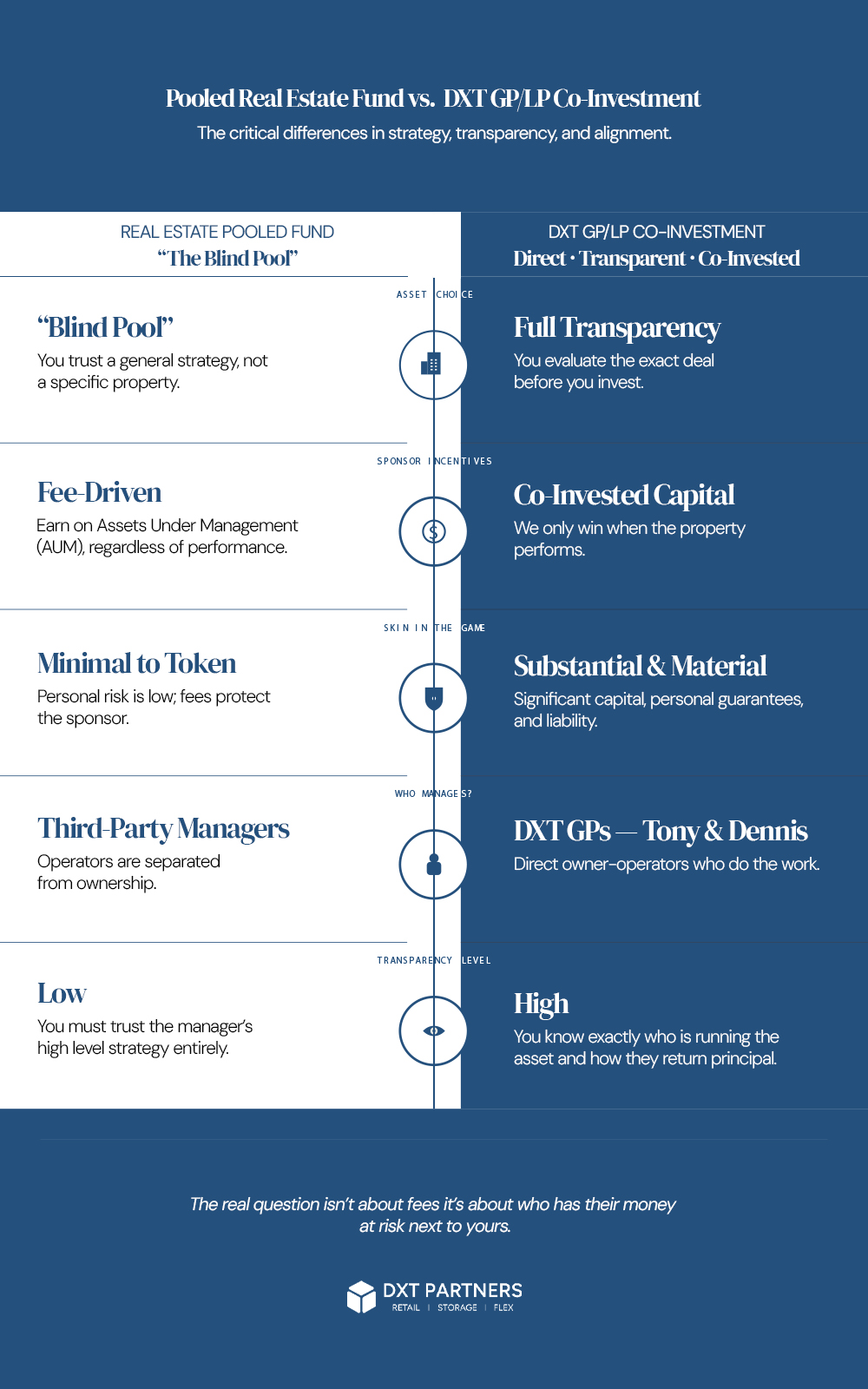
Side by Side: Real Estate Fund vs. DXT GP/LP Co-Investment
Here is a simple comparison to make the differences concrete:
Feature | Real Estate Pooled Fund | DXT GP/LP Co-Investment |
What you’re buying into | Blind pool: strategy-based, no specific asset known upfront | Specified property: full transparency on what you’re investing in |
How the sponsor gets paid | Often fee-driven (AUM-based, regardless of performance) | Standard operational fees apply, but the primary incentive is co-invested capital, we earn our returns the same way you do, by the deal performing, not by collecting fees on your money |
Who manages the property | Third-party property managers | Direct owner-operators (Dennis and Tony) |
Sponsor skin in the game | Minimal: fees protect them regardless of outcome | Substantial: own money, personal guarantees, sweat equity |
Risk management | Market diversification | Strict due diligence and shared financial risk |
Transparency | Low: you trust the strategy | High: you see the deal before you invest |
The Asset Classes DXT Focuses On, And Why They Hold Up
One reason this partnership model works so well at DXT is that self-storage and flex space are among the most resilient commercial real estate categories you can find.
Flex spaces, those small warehouse units used for light manufacturing, e-commerce operations, contractor storage, or office work, tend to command higher rents than traditional warehouses and attract a diverse mix of small business tenants.
What DXT does particularly well is use a single metal frame building for multiple purposes at once: retail, self-storage, and flex space. With a simple metal frame building, DXT Partners can leverage the space for the highest and best use, which includes retail, storage, and flex spaces combined. That flexibility is how they squeeze more value out of every acquisition.
The Tax Benefits That Flow to LP Partners
One of the most underappreciated advantages of a GP/LP structure is what happens at tax time.
As a Limited Partner, you receive a K-1 each year. The K-1 passes through your share of the investment’s income, expenses, and depreciation directly to your personal tax return. That depreciation, the paper “loss” that comes from the wear and tear on a physical building, can offset your passive income and, depending on your tax situation, even your ordinary income.
When GPs are owner-operators doing the work themselves, they can also pursue cost segregation studies, a process that breaks down a building into its individual components and accelerates the depreciation schedule for certain items. This front-loads more tax savings in the early years of ownership, and those savings flow directly to LP partners.
This is not hypothetical. For many LP investors, the tax benefits of a single co-investment can shelter significant amounts of income in year one. It is one of the reasons passive real estate investing has long been a tool used by high-income professionals looking to reduce their tax bills.
The Track Record Behind the Partnership
DXT Partners currently manages 13+ properties, covering 458,000+ square feet of space and representing over $130 million in assets under management, in collaboration with Greenridge Management.
Their portfolio spans self-storage, flex space, retail centers, and boat and RV storage, all across the greater Houston area and Southeast Texas. Properties include Safe Harbor Storage in Kemah, Woodlands Storage and Flex Spaces in Magnolia, and Humble Storage with a planned 12,000 sq ft flex expansion, among many others.
Every single one of those properties started as an underperforming asset that the team found, evaluated, acquired, improved, and stabilized. That is the system. And it works.
Our first deal together nearly tripled the property’s value in under two years. That same combination of engineering precision, entrepreneurial thinking, and direct seller relationships is what they bring to every deal today.
What This Means for You as an Investor
If you want maximum diversification across dozens of properties and you do not need to know exactly what your money is in, a real estate fund might fit your goals. That is a legitimate choice.
But if you want to know exactly which property your money is backing, exactly who is running it, and exactly how they are structuring the return, and you want to invest alongside people who have their own money at risk right next to yours, then a GP/LP partnership with an owner-operator is a completely different experience.
The key question to ask any GP is simple: Are you investing in this deal too?
If the answer is yes, and they can show you their track record, their plan for the specific property, and how they structure returns so their upside only comes after yours, that is the kind of alignment that makes passive investing feel a lot more like a partnership than a transaction.
At DXT Partners, the answer to that question is always yes.

Ready to Take a Closer Look?
DXT Partners is building a portfolio of recession-resistant Texas assets, self-storage, and flex spaces in growing markets across the greater Houston area. We are not looking for passive capital to park in a pool. We are looking for partners who want to build real wealth over the long term, backed by a team that treats every deal as its own.
If that sounds like the kind of investing you want to be doing, the next step is simple: apply for access to the DXT Investor Portal to review their current co-investment opportunities and track record.
Become an Investor at DXT Partners
Disclaimer: This content is for informational purposes only and does not constitute investment advice. All investments carry risk, including the potential loss of principal. Past performance does not guarantee future results.