US Self-Storage Industry Outlook: Key Market Drivers
The housing unlock is coming. One of the biggest demand drivers for self storage has always been people moving. When someone sells a home, downsizes, relocates for a job, or goes through a divorce, they almost always need storage. For the past two years, the housing market has been largely frozen. High mortgage rates locked millions of homeowners in place, they had equity, but moving meant trading a 3% rate for a 7% rate. That math stopped working.
As the Federal Reserve continues its rate-cutting cycle, that dynamic is beginning to change. Mortgage rates are easing, transaction volumes are picking up slowly, and pent-up relocation demand is building. Each percentage point drop in mortgage rates releases another wave of homeowners who have been waiting to move. When they do, they bring storage demand with them.
New supply is peaking and pulling back.
The construction boom that followed the pandemic is winding down. New supply is forecast to fall to around 2.4% of total existing stock in 2026, down from 3.0% in 2025 and well below the long-term average of 4.2%.
Nationally, approximately 46.2 million net rentable square feet remained under construction in early 2026, but that number has been declining month over month. As the pipeline empties and developers stay cautious, existing facilities in supply-constrained markets will regain pricing power through 2027 and 2028.
The Sun Belt remains the core market, with nuance. Texas and Florida continue to attract the most population growth, the most new business formation, and the most storage demand of any region in the country.
Texas cities like Katy and Tomball have seen storage search volumes among the highest in the nation. However, specific metros like Houston face elevated near-term supply from a large 2026 delivery pipeline. The takeaway is that Texas remains the right state to operate in, but market selection within Texas matters more than ever. Not every zip code is the same story.
Self Storage Trends: What Is Shaping the “New Normal”?
Experience over commodity. For decades, self storage was a pure commodity. You paid for a box, you got a box. That era is ending. As the market normalizes and competition increases, the facilities that win are the ones that make tenants feel like valued customers rather than unit numbers. That means clean, well-lit facilities, responsive staff or AI-driven service tools, simple digital onboarding, and proactive communication. The operators who treat storage as a service product rather than a passive income stream are seeing stronger occupancy and lower churn.
The side-hustle tenant is a real and growing segment. One of the most significant demographic shifts in self storage right now is the rise of the e-commerce micro-merchant. A small business selling products on Etsy, Amazon, or Shopify needs somewhere to stage inventory, process returns, and pack shipments.
A 10×20 climate-controlled unit is cheaper and more flexible than a formal warehouse lease. Business tenants are expected to grow at nearly a 5% compound annual rate through 2031, and they tend to stay longer and treat their units with more care than residential customers.
Sustainability is becoming a real differentiator.
ESG (Environmental, Social, Governance) considerations are no longer just for institutional investors. Operators who install solar panels, use cool-roof membranes, and upgrade to energy-efficient HVAC systems are reducing operating expenses and accessing a growing pool of ESG-conscious investors and tenants. A solar-powered facility can meaningfully cut electricity costs, a major operating line item, while also differentiating itself in a crowded market.
Self Storage Technology News: The AI Revolution
If there is one theme separating the winners from the losers in self storage right now, it is technology. Specifically, AI. And the gap between operators who have adopted it and those who have not is widening fast.
AI-powered pricing is now table stakes:
Dynamic pricing, adjusting rates daily or even hourly based on occupancy, local demand, and competitor moves, used to be something only the largest REITs could afford. Now, AI-driven revenue management platforms make it accessible for mid-size operators.
A survey by Storable found that 78% of operators plan to implement AI pricing and demand forecasting tools in 2026. Operators using these tools outperform those using manual pricing by a meaningful margin, because they never leave money on the table during high-demand periods and never lose tenants unnecessarily during slow periods.
Contactless is the new standard:
The old keypad at the gate is being replaced by smart locks, facial recognition, and mobile app access. Tenants can now rent a unit, sign their agreement, pay their first month, and access their space without speaking to a single person, all from their phone.
This is not just a convenience play. It dramatically reduces labor costs and extends effective facility hours to 24/7 without adding staff. Access-control technology typically recovers its upfront cost within 12 to 18 months through labor savings and reduced security incidents alone.
One manager, multiple sites:
Perhaps the most transformative operational change in the industry is the cluster management model. Using remote monitoring, smart locks, and AI-driven customer service tools (chatbots, AI voice agents, automated billing), a single trained manager can now oversee two, three, or four facilities simultaneously. This collapses the labor cost structure that used to make small and mid-sized facilities uncompetitive. For investors, it means the economics of owning a portfolio of smaller assets are dramatically better than they were five years ago.
Self Storage Industry Statistics: The Data Behind the Growth
Here is a clear-eyed look at where the numbers stand as of mid-2026:
- $47.3 Billion U.S. self storage market value in 2026
- $57.8 Billion Projected market value by 2031
- ~92% Institutional operator average occupancy
- ~82% Overall market average occupancy
- $119/month Average 10×10 non-climate unit (monthly)
- $134/month Average 10×10 climate-controlled unit (monthly)
- 2.1+ Billion sq ft Total U.S. storage inventory
- ~40% Millennials as share of renter base
A few of these numbers deserve context.
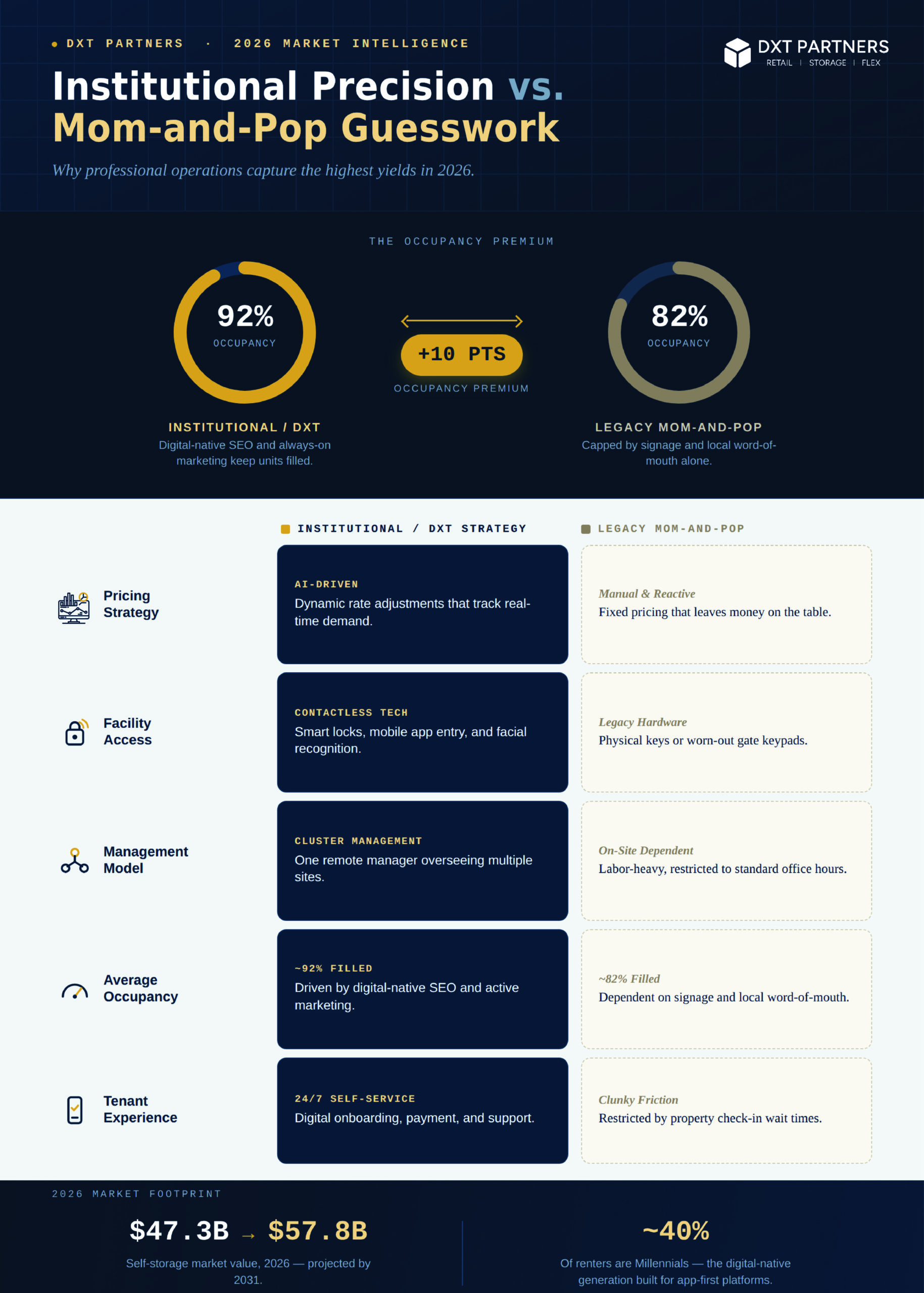
The gap between institutional occupancy (~92%) and the overall market average (~82%) is the most important data point for investors. It tells you that technology and professional management directly translate into 10 percentage points of additional occupancy, which, at scale, is a massive revenue difference. The facilities performing at the bottom of that range are largely legacy, under-managed mom-and-pop operations. The ones at the top are professionally managed, digitally native, and operationally tight.
On the demographic side, millennials now representing roughly 40% of the renter base is not just a feel-good statistic. It means the future of this business is digital. Millennials search for storage online, rent online, pay online, and access their units via mobile app. Any facility still relying on walk-in traffic and phone bookings is already behind.
Self Storage Market Analysis: Is the Sector Still a “Safe Haven”?
Self storage has earned its reputation as one of the most recession-resilient commercial real estate sectors. The reason is simple: the demand triggers for storage are life events, not economic cycles. People still move, downsize, divorce, and die in recessions. Businesses still need to store inventory when sales are slow. And the average tenant stays in their unit for 18 to 19 months, which means revenue is stickier than most asset classes.
That said, 2026 is not a market where you can simply buy any storage facility and expect strong returns. Rate softness is real. Construction in some markets has outpaced demand. And the higher-for-longer interest rate environment has made debt more expensive and forced buyers to underwrite more carefully. This is a market that rewards discipline, not just capital.
The consolidation wave is accelerating. Large private equity firms and institutional players are actively targeting Class B and Class C facilities for value-add conversions. They buy at a discount, upgrade the systems, reprice the units, and reposition the asset to institutional quality. This is not a new strategy, but the pace is accelerating because the supply of underperforming legacy facilities is large, and the value-add spread is compelling in a market where new development no longer pencils in most metros.
The flex space advantage
At DXT Partners, we also see industrial flex space as the natural hedge to self storage saturation. While traditional storage markets face near-term rate pressure from oversupply, small bay flex industrial, the 1,500 to 5,000 square foot workshop and warehouse units serving tradespeople, e-commerce operators, and small manufacturers, is running at record-low vacancy with virtually no new supply coming to market. For investors building a real estate portfolio, combining self storage with flex space exposure is a powerful diversification strategy.
Institutional vs. Mom-and-Pop: How the Gap Is Growing
Factor | Institutional Operator | Mom & Pop Operator |
Pricing Strategy | AI-driven, daily dynamic | Manual, reactive |
Access Tech | Smart lock / mobile app | Key or basic keypad |
Management Model | Remote multi-site | On-site single facility |
Occupancy (avg) | ~92% institutional | ~82% overall |
Marketing | SEO + digital-native | Word of mouth / signs |
OpEx Efficiency | Lower (tech-optimized) | Higher (labor-heavy) |
Tenant Experience | 24/7 self-service | Office-hours dependent |
Recession Response | Dynamic rate adjustments | Slow to respond |
The DXT Strategy for 2026 and Beyond
At DXT Partners, we do not just observe market cycles; we build strategies around them. With over $130 million in assets under management across 458,000+ square feet, our team has spent years identifying the markets, asset types, and operational models that generate durable returns regardless of where we are in the cycle.
We find the path of progress before it shows up in reports.
Most institutional capital chases markets that are already well-documented, cities where the growth story is in every headline and the prices already reflect it. We take a different approach. We look for Texas submarkets where population is growing, small business formation is accelerating, and the current storage supply is aging and under-managed. By the time a market shows up in a major broker report, the best acquisition opportunities are already gone.
Digital-native operations from day one.
Every facility we operate or acquire gets the same technology stack: AI-driven revenue management, mobile-app access, smart locks, automated billing, and digital leasing. This is not a nice-to-have. It is the operating standard that allows us to maximize occupancy, reduce labor costs, and deliver a tenant experience that drives renewals. We do not inherit old systems and work around them, we replace them.
Why the 2026–2028 window matters for investors.
Interest rates are falling, but not fast enough to have fully repriced assets yet. Cap rates in self storage are still elevated relative to where they will be in two or three years if rate normalization continues. That means today’s buyers are acquiring income-producing assets at yields that may not be available in 2028. Combined with the supply pullback that is already underway, the investors who move in 2026 and 2027 have a realistic path to both strong current income and meaningful appreciation as the cycle turns. This is the wealth-creation window, and it is open right now.
“In real estate, the best time to buy is when everyone else is still debating whether to. The data in 2026 is clear: supply is contracting, demand is steady, and the operators with technology are pulling away from the pack.”

Conclusion: Preparing for the Next Decade of Storage
The self storage industry is not broken. It is normalizing. And normalization, for a well-prepared operator with the right assets and the right technology, is exactly the environment where outperformance becomes possible.
The investors who rushed in during the pandemic boom chasing headline numbers are now the ones sitting on overleveraged assets in oversupplied markets. The investors who are doing the careful work now, buying strategically, operating efficiently, and building digital infrastructure, are the ones who will look back at 2026 as the year they made their best acquisitions.
At DXT Partners, we are actively deploying capital in this environment. If you want to understand where we are investing, what our current assets look like, and how our strategy translates into investor returns, we would like to show you.
View our portfolio and current projects or reach out to our team directly to request our updated investor prospectus and get a firsthand look at the opportunity set we are working with in 2026.