1031 Exchange Property Ownership Requirements: The Rules of the Game
Before you can benefit from a 1031 exchange, you need to understand the basic rules the IRS requires you to follow. They are strict but not complicated.
The “Like-Kind” Definition: Broader Than You Think
Many people assume a 1031 exchange means you have to trade one warehouse for another warehouse, or one apartment building for another apartment building. That is not how it works. “Like-kind” simply means both properties must be held for investment or business purposes.
An apartment building can be exchanged for a self-storage facility. A rental house can be exchanged for a commercial flex space. The asset type does not have to match, the investment intent does.
The “Held for Productive Use” Rule
The IRS draws a clear line here: your primary home does not qualify for a 1031 exchange. Neither does a vacation property that you use mostly for personal trips. The property you are selling (called the “relinquished property”) must have been held for investment or productive business use. The same goes for the new property you are buying (called the “replacement property”). Both sides of the exchange must serve an investment purpose.
The Same Taxpayer Rule
This rule catches a lot of people off guard. The person or entity that sells the relinquished property must be the exact same person or entity that buys the replacement property. If you sell a property in your personal name, you cannot buy the new one through your LLC. The title on both sides of the exchange must match.
The 1031 Exchange Timeline: Deadlines You Cannot Miss
The IRS is not flexible about timing. Miss either of these deadlines, and the exchange fails, meaning your full gain becomes taxable immediately.
Day 1 to Day 45
From the day you close on the sale of your old property, you have exactly 45 days to identify your replacement property in writing. This notice must go to a Qualified Intermediary (QI), not your accountant, not your attorney, and definitely not yourself.
Note: The QI is a neutral third party that manages the exchange funds and paperwork.
Day 1 to Day 180
The entire exchange, from selling your old property to closing on your new one, must be completed within 180 days. This clock starts running the moment you close on the sale, not when you identify the property.
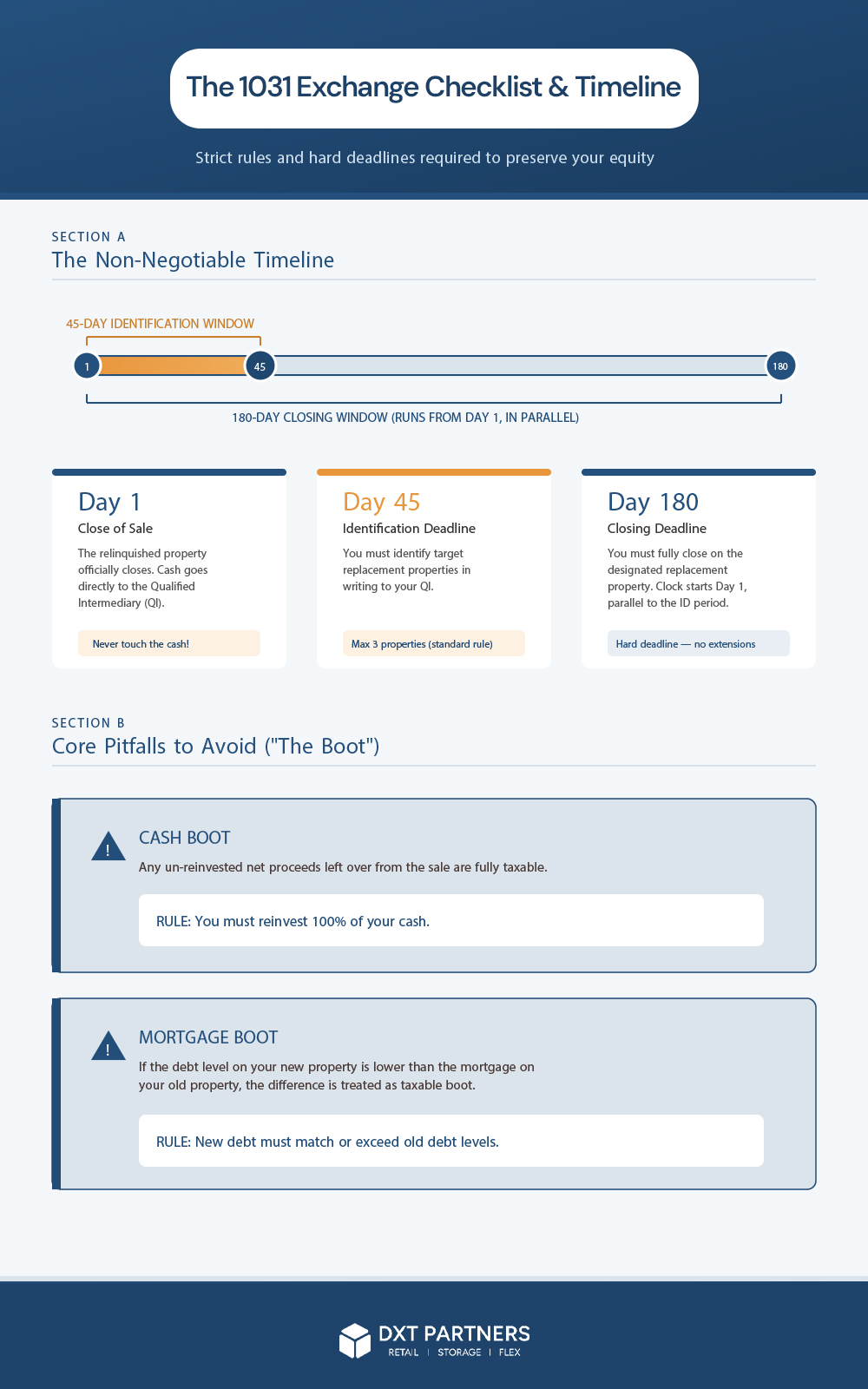
Critical Rule: Never Touch the Cash.
This is perhaps the most important rule of all. You cannot receive the proceeds from the sale of your relinquished property at any point during the exchange. The money must go directly to the Qualified Intermediary, who holds it in escrow. If the cash ever lands in your hands, even for a single day, the IRS treats it as a completed sale, and the full tax bill becomes due immediately.
1031 Exchange Investment Property Selection Strategies
The IRS gives investors three options for identifying replacement properties during the 45-day window. Each one fits a different situation.
The Three-Property Rule
This is the most common approach. You identify up to three potential replacement properties, regardless of their value. It does not matter if one property is worth $200,000 and another is worth $2 million. As long as you name no more than three, you are within the rules. Most investors use this route because it keeps things simple and focused.
The 200% Rule
This option lets you identify more than three properties, but only if the combined value of all identified properties does not exceed 200% of the value of the property you just sold. For example, if you sold a building for $1 million, you can identify any number of properties as long as their total value stays under $2 million. This is useful when a buyer wants to keep their options open across multiple smaller deals.
The 95% Rule
This is a much less common strategy and is generally only used in specific circumstances. It allows you to identify as many properties as you want with no limit on total value, but only if you actually close on at least 95% of the total value of everything you identified. Because the math is hard to hit precisely, this rule is typically a last resort rather than a first choice.
Navigating “Boot” and Mortgage Boot
One of the most misunderstood parts of a 1031 exchange is the concept of “boot.” In simple terms, a boot is anything the IRS considers a taxable event within an otherwise tax-deferred exchange.
Cash Boot
If you sell your property for $1 million but only reinvest $900,000 into the replacement property, the leftover $100,000 is called a cash boot, and it is fully taxable. To defer 100% of your gain, you must reinvest all of the proceeds from your sale, not just most of them.
Mortgage Boot
This is where many investors get tripped up. It is not enough to just match the purchase price. You also need to match or exceed the debt level. If you had a $600,000 mortgage on the property you sold, your new property must carry at least $600,000 in debt.
If it carries less, say only $400,000, the $200,000 difference is treated as mortgage boot and becomes taxable. You can offset the mortgage boot by adding more cash to the deal, but reducing your debt level without compensating triggers a tax event.
Why Self-Storage and Flex Space Are Elite 1031 Targets
Not all replacement properties are created equal. The goal of a 1031 exchange is not just to defer taxes, it is to put that deferred equity into a better asset. Self-storage and flex space have become some of the most attractive destinations for 1031 exchange capital, and for good reason.
Consolidation: Trading Headaches for Income
Many investors come to a 1031 exchange carrying the weight of a “mom and pop” rental, a single-family house or small apartment building that demands constant attention. Tenant calls, maintenance issues, and unpredictable cash flow drain both time and energy. A 1031 exchange is the perfect tool to sell that high-maintenance property and roll the equity into a professionally managed project.
As DXT Partners puts it:
“Self-storage offers several advantages over other real estate types: lower maintenance costs, recession-resistant demand, easier tenant management, and strong cash flow. “
Storage tenants also tend to stay longer than apartment renters. That kind of stability is exactly what a 1031 exchange investor is looking for in a replacement property.
Yield Migration: Moving From Low-Return Markets to High-Growth Ones
A 1031 exchange is also a way to upgrade the quality of your market, not just your asset. Many investors are sitting on equity in high-cost “gateway” cities like New York or Los Angeles, where property prices are high but the rental income relative to that price (called the cap rate) is often disappointingly low. A 1031 exchange allows you to sell in a low-yield market and move that equity into a faster-growing market like Texas, where demand is strong and cap rates are higher.
Portfolio Diversification: From Single-Family to Multi-Tenant
A single-family rental puts all of your income in one tenant’s hands. If they leave or stop paying, your cash flow drops to zero. A multi-tenant flex business park spreads that risk across dozens of small businesses, if one moves out, the others keep paying. A 1031 exchange is an efficient way to make that shift without triggering a tax bill in the process.
Why Texas Storage and Flex Space?
When businesses grow, they need more space. When they struggle, they downsize and need storage. When families move, buy things, or declutter, they need self-storage. No matter what happens, these properties stay full and profitable.
That is the kind of durability that makes self-storage and flex space ideal 1031 exchange destinations, assets that hold their value across economic cycles.
1031 Property Exchange vs. Delaware Statutory Trust (DST)
If you want to do a 1031 exchange but do not want to be the sole owner of a new property, managing it yourself or taking on the full debt obligation, there is another path worth knowing about: the Delaware Statutory Trust, commonly called a DST.
What Is a DST?
A DST is a legal structure that allows multiple investors to each own a fractional share of a single large property. Because each investor holds a direct legal ownership interest in the property (not just a share in a fund), the IRS considers it a valid replacement property for 1031 exchange purposes. This means an investor can satisfy their 1031 obligations without being the sole owner or manager of the asset.
DST Benefits
DSTs tend to have lower minimum investment thresholds than full direct ownership, often starting around $100,000. They come with professional management already in place and pre-arranged financing, so the investor does not need to secure a loan themselves. For investors who want passive income without operational involvement, DSTs can be a convenient option during the tight 1031 exchange timeline.
When to Choose Which
Feature | Direct 1031 Ownership (e.g., DXT GP/LP) | Delaware Statutory Trust (DST) |
Control Over the Asset | Full or co-ownership with active operators | No control: passive fractional ownership |
Minimum Investment | Varies; typically higher per deal | Often starts around $100,000 |
Financing | Investor or GP arranges debt | Pre-arranged, no loan required from investor |
Asset Visibility | You know exactly which property you own | Specified but managed by a trust sponsor |
Operator Alignment | GP co-invests and operates directly | Third-party sponsor manages for fees |
Future 1031 Options | Property can be exchanged again later | DST interests cannot be 1031-exchanged again directly |
Best For | Investors who want strong returns and transparency | Investors who need a fast, simple exchange solution |
The DST has a key limitation that often matters in the long run: once you are in a DST, you generally cannot do another 1031 exchange out of it. That means the “swap till you drop” strategy, which we explain below, becomes difficult to execute inside a DST structure. For investors focused on building long-term, compounding wealth, direct GP/LP co-investment tends to offer more flexibility.
Tax Advantages Flowing Through the Partnership
A 1031 exchange is not the only tax benefit that comes with owning investment real estate through a GP/LP structure. There are additional advantages that work in your favor year after year.
The K-1 Advantage
As a limited partner (LP) in a real estate deal, you receive what is called a K-1 tax form each year. This form passes through your share of the property’s income and expenses directly to your personal tax return. Crucially, it also passes through your share of depreciation, a paper loss that can offset real income. Many investors find that the depreciation from their real estate partnerships significantly reduces, or even eliminates, their taxable income from those same investments.
Cost Segregation
Cost segregation is a tax engineering strategy that allows property owners to accelerate depreciation deductions. Instead of depreciating a building over 39 years (the standard IRS schedule for commercial real estate), a cost segregation study identifies portions of the building, lighting, flooring, landscaping, certain equipment that can be depreciated much faster, sometimes in as little as 5 to 15 years.
When owner-operators like DXT Partners run a cost segregation study on a property, those accelerated depreciation benefits flow directly to LP investors through their K-1 forms. The result is that investors often report paper losses from their investment in years when the property is actually producing strong cash returns, a meaningful tax shield that most passive investors in funds never get access to.

The DXT Refinance Advantage:
Upon stabilization of an asset, the DXT Partners team refinances the debt to return principal investments to investors. Investors retain asset ownership and free cash flow without having to pay the taxes typically associated with a sale. This means investors can get their money back and still own the asset, with a 1031 exchange reserved as an additional option if and when the property is eventually sold.
Conclusion: “Swap Till You Drop”: The Exit Strategy for Life
A 1031 exchange is a legitimate economic tool codified in the Internal Revenue Code, designed to encourage continued investment in productive real estate. Congress created it because reinvesting in real estate creates jobs, improves communities, and grows the economy. and the tax deferral is the incentive.
The “swap till you drop” strategy is simple in concept: keep exchanging one property for another across your investing lifetime, deferring capital gains each time. When you eventually pass your real estate holdings to your heirs, those properties receive a step-up in cost basis, meaning the accumulated deferred capital gains can disappear entirely. Done correctly, a 1031 exchange can be a cornerstone of genuine, multi-generational wealth building.
But the strategy only works if you follow the rules precisely, the 45-day window, the 180-day close, the same taxpayer requirement, the debt matching. Miss any one of them and the tax bill comes due immediately.
Our mission is to identify, acquire, and operate high-performing assets that deliver strong, risk-adjusted returns to investors, creating long-term value through strategic market selection, operational efficiency, and disciplined asset management. That includes helping our investor partners navigate the strict 1031 exchange timeline so their wealth keeps compounding, not evaporating, with every transaction.