Why Sellers Choose to Finance Their Own Facility
Before you can put together a seller-financed deal, it helps to understand why a seller would ever say yes to one. It comes down to three things: taxes, returns, and peace of mind.
The Tax Shelter: The Installment Sale Benefit
Most long-time self-storage owners have built up a lot of equity in their properties. A facility bought for $500,000 twenty years ago might be worth $2.5 million today. Sell it all at once, and the owner could owe capital gains tax on the full $2 million profit in one tax year, a big hit.
Seller financing changes that. Under what the Internal Revenue Service (IRS) calls an “installment sale,” the seller only pays capital gains tax on the part of the profit they actually collect each year. Instead of one huge check to the government, the tax bill gets spread out over 5, 7, or even 10 years, so the seller keeps more of their money.
For a retiring owner sitting on decades of growth in their property’s value, this alone is often reason enough to say yes.
Returns That Beat the Alternative
Here’s the other side of it. When a seller takes a lump sum, they still have to put that cash somewhere. In 2026, a safe Certificate of Deposit (CD) or government bond pays around 3–4%.
Note: A Certificate of Deposit is a savings product a bank offers where you lock your money in for a set period of time (say, 6 months or 2 years) in exchange for a fixed interest rate that’s usually a bit higher than a regular savings account. It’s called “safe” because it’s FDIC-insured up to $250,000 per depositor per bank, meaning even if the bank fails, the government guarantees your money back.
Compare that to the 4–7% a seller can earn by becoming the bank for the right buyer, backed by a property they know better than anyone, since they ran it for years. That’s a real step up from parking the money in a bank account, for a seller who already knows exactly what their property is worth.
Retirement Income Without the Headaches
Running a self-storage facility is real work, tenants to manage, gates to fix, rent to collect, late accounts to chase. After 20 years of that, most sellers don’t want to do it for another decade.
Seller financing turns the facility into something else: a mailbox. Every month, a payment shows up. No tenants, no repairs, no calls at midnight. The former owner keeps earning from the property they built, without any of the work that used to come with it.
How These Deals Get Structured
Every seller-financed deal looks a little different because every seller’s situation is different. Still, most deals in the market share a few common pieces.
Not Always the Whole Loan
Seller financing doesn’t have to cover the full purchase price. Sometimes it’s used to fill the gap between what a bank is willing to lend and what the deal actually costs.
The Down Payment
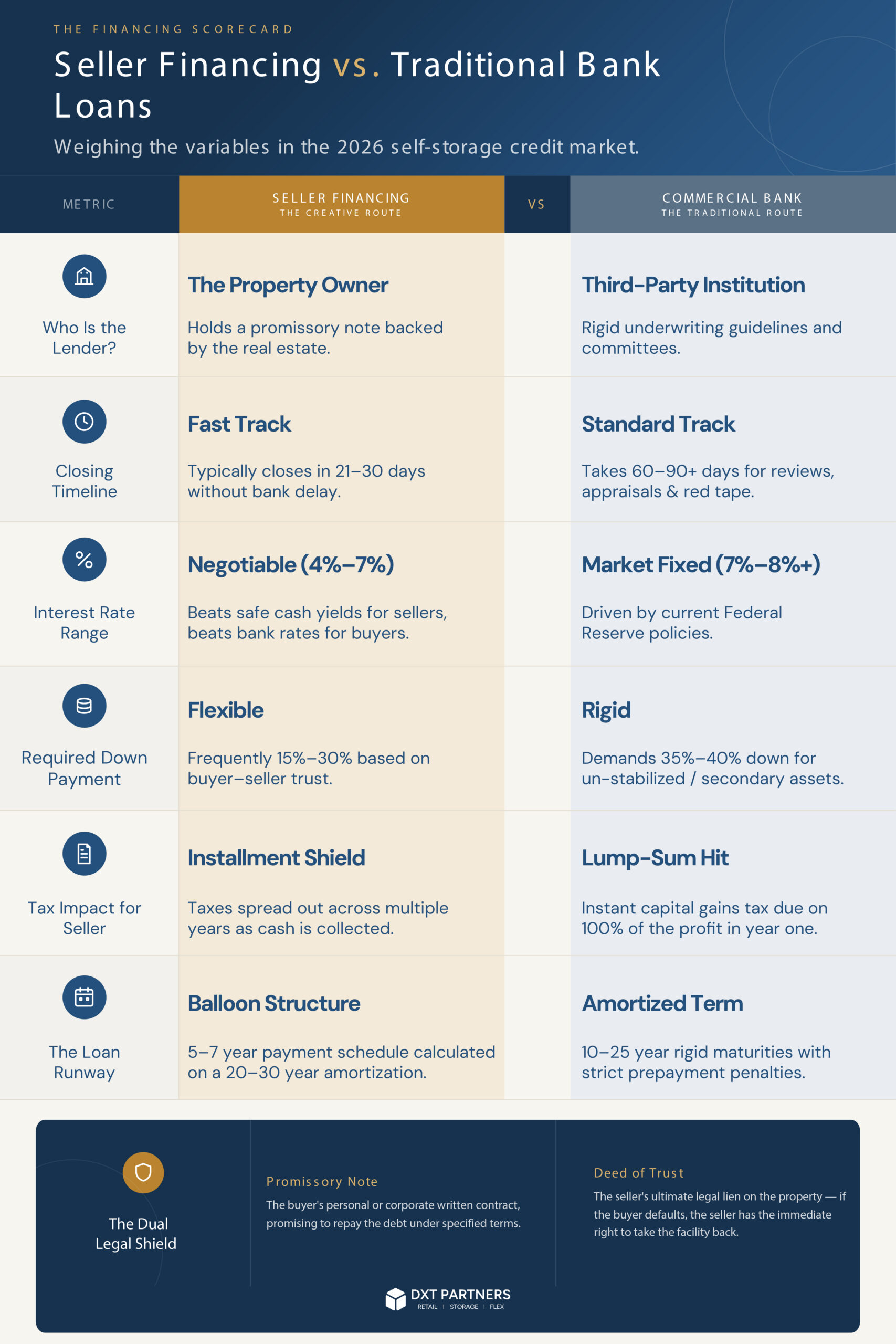
Buyers typically put 15% to 30% down at closing, well below the 35% to 40% most banks now ask for on self-storage properties that aren’t fully rented up or sit in smaller markets.
The Interest Rate
There’s no set “market rate” for seller financing, and that’s part of what makes it work for both sides. Most of the deals we see land somewhere in the 4% to 7% range, a rate that beats what a seller would earn on a CD or bond, while still coming in below what a bank would charge a buyer for a similar commercial loan (currently running 7–8%). It tends to work out well for everyone: the seller earns more on their money than with any safe alternative, and the buyer secures financing that’s genuinely cheaper than the bank down the street.
The Balloon Payment
Most sellers don’t want to wait 30 years to get paid in full. That’s why almost every seller-financed deal includes a “balloon payment”, a set date, usually 5 to 7 years out, when the buyer has to pay off whatever balance is left.
This works well for both sides. The seller knows exactly when they’ll get their full payout. The buyer gets time to stabilize the property, grow the income, and qualify for a regular bank refinance before that date arrives.
It also gives the seller real protection along the way. Because the note is backed by the property itself, if a buyer ever stops paying, the seller isn’t stuck just chasing a debt; they have the legal right to take the property back.
The Amortization
Even though the full balance is due in 5 to 7 years, the monthly payment is usually calculated as if the loan were spread out over 20 to 30 years. That’s called amortization; the longer the schedule, the smaller the monthly payment, which matters when a buyer is trying to make a property cash flow from day one.
Easing Into Full Payments
On some deals, especially ones where the buyer plans to raise rents or upgrade the property early on, the seller may agree to lower or interest-only payments for the first 12 to 24 months. This gives the buyer breathing room to make improvements before the full payment kicks in.
What This Means for Buyers
Seller financing isn’t just a backup plan for when the bank says no. In a lot of cases, it’s simply the better deal.
Speed of Closing
A regular bank loan can take 60 to 90 days or more to close, appraisals, environmental reviews, credit committee approvals, any of which can slow things down or fall apart. Seller-financed deals, with no bank in the middle, often close in 21 to 30 days.
Lower Closing Costs, For Both Sides
A bank loan comes with a long list of fees: origination fees, appraisal costs (often $5,000 or more), environmental review charges, and other add-ons that push closing costs to 2–3% of the loan amount.
Seller financing cuts most of that out for everyone. ]The real costs are a real estate attorney to draft the paperwork (which any deal needs anyway) and a title company to handle closing.
Flexible Underwriting
Banks lean on strict formulas. If a property is sitting at 65% occupied when it’s sold, a lot of banks will simply pass, no matter how good the buyer’s plan is to fix it.
A seller who ran the property for 20 years understands exactly why occupancy is where it is, and whether a motivated buyer can turn it around. They can look at the whole picture instead of one snapshot number.
Who Makes a Good Seller Financing Candidate
Here’s how to spot the right ones.
The “Debt-Free” Requirement
This is the biggest factor: the seller has to own the property free and clear. Owners who have held their facilities for 15 to 30 years tend to be the best candidates. They’ve paid off their debt, built up full equity, and are in a position to become the bank themselves.
The Retiring Operator
The classic seller financing candidate is the “mom and pop” operator, someone who bought a facility decades ago, ran it themselves, and is now approaching retirement.
The Value-Add Facility
Seller financing pairs especially well with properties that need better management, not major construction, manual gates, paper rental forms, and no online payments. These properties are often undervalued because their income doesn’t reflect what they could earn.
Risks and Protections: The Fine Print
Seller financing is a powerful tool, but only when it’s set up right. Cutting corners here can hurt both sides.
Do Your Homework Before You Sign
Don’t just take a seller’s word for occupancy or income numbers. Buyers should check actual occupancy, review every active lease, and run the numbers against a worst-case scenario: a rate drop, a new competitor opening nearby, a slower market. A walk-through of every unit matters too. Anything that doesn’t match what the seller reported is worth raising before you agree on a price or terms, not after.
If You’re the Seller: Know Who You’re Financing
Seller financing only works if the buyer can actually run the place and make the payments. If you’re the seller, it’s fair and smart to ask for a real business plan, check the buyer’s credit, and look into their background before you agree to carry the note. You’re not just selling a property. You’re becoming their lender for years to come, so it’s worth knowing who you’re lending to.
The Promissory Note and Deed of Trust
Every seller-financed deal needs two documents: a promissory note and a deed of trust (or mortgage, depending on the state).
The promissory note is the buyer’s written promise to repay; it spells out the loan amount, interest rate, payment schedule, balloon date, and what happens if payments stop. The deed of trust gives the seller a legal claim on the property, so if the buyer stops paying, the seller has the right to take it back.
These need to be drafted by a real estate attorney. Skipping that step to save a little money, or using an online template, is a mistake that can cause real problems later. A good attorney is a small cost for that kind of protection.
Default Clauses
Both sides need to know what happens if payments stop. The deed of trust gives the seller the right to foreclose and take the property back if the buyer defaults.
Most notes also include a “cure period”, usually 30 to 60 days, giving the buyer a set window to catch up on missed payments before foreclosure starts. For the buyer, that’s real protection during a rough month. For the seller, it means they can still act if a buyer keeps missing payments.
Insurance and Taxes
Once the deal closes, the buyer owns the property and is responsible for keeping up the asset on which the seller’s note depends. Two things aren’t optional.
First, the buyer has to keep proper insurance on the property and show the seller proof of coverage every year. If the property burns down with no insurance, the seller’s security goes with it.
Second, the buyer has to stay current on property taxes; unpaid taxes create a claim that can jump ahead of the seller’s note. Most well-written agreements require the buyer to show proof of paid taxes each year, which protects both sides.

Creative Capital for a Changing Market
Seller financing isn’t a workaround. It’s a well-established tool that’s been used in commercial real estate for decades, and in a 2026 market where bank lending is slow, expensive, and rigid, it matters more than ever.
For sellers, it means spreading out taxes, earning more than a bank account would pay, real legal protection if something goes wrong, and steady monthly income without the work of running the place. For buyers, it means faster closings, lower costs, more flexible terms, and access to good properties that banks won’t finance.
At DXT Partners, we’ve built our approach around relationships with self-storage owners that lead to exactly this kind of deal, one that works for everyone at the table. We have spent years building the local knowledge and owner relationships it takes to find these deals and make them work.
When the right deal meets the right structure, everyone wins. That’s the advantage of creative financing, and it’s open to any investor or any owner thinking about their next step, willing to have the conversation.
If you’re a self-storage owner curious about what your options look like, or an investor who wants to understand how these deals come together, we’d be glad to talk it through with you, no pressure, just a conversation. Reach out to us anytime.